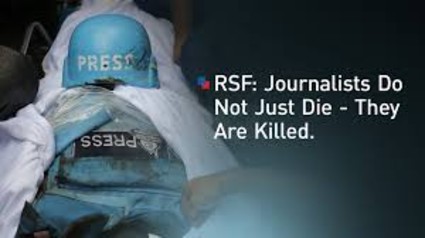
Journalists do not just die – they are killed. The number of murdered journalists has risen again, due to the criminal practices of military groups — both regular and paramilitary — and organised crime. At least 53 of the 67 media professionals killed over the past year are victims of war or criminal networks, the Reporters Without Borders (RSF) said in a report.
Nearly half (43%) of the journalists slain in the past 12 months were killed in Gaza by Israeli armed forces. In Ukraine, the Russian army continues to target foreign and Ukrainian reporters. Sudan has also emerged as an exceptionally deadly war zone for news professionals.
In Mexico, organised crime groups are responsible for the alarming spike in journalist murders seen in 2025. This year has been the deadliest of the past three years — at least — and Mexico is the second most dangerous country in the world for journalists, with nine killed. The trend has spread as Latin America has become more “Mexicanised,” accounting for 24% of the world’s murdered journalists.
Journalists are more at risk within their own countries. Only two foreign journalists were killed this year: French photojournalist Antoni Lallican, killed by a Russian drone strike in Ukraine, and Salvadorian journalist Javier Hércules, killed in Honduras, where he had lived for over a decade. All the other murdered journalists reported the news in their own nations.
503 journalists are currently detained around the world. The world’s largest prison for journalists is still China (121), with Russia (48) now in second place, imprisoning more foreign journalists than any other state: 26 Ukrainians. Myanmar (47) comes in third.
One year after the fall of Bashar al-Assad’s regime, many of the reporters arrested or captured under his rule are yet to be found, making Syria the country with the highest number of missing news professionals — over a quarter of the world total.
“This is where the hatred of journalists leads! It led to the death of 67 journalists this year – not by accident, and they weren’t collateral victims. They were killed, targeted for their work. It is perfectly legitimate to criticise the media — criticism should serve as a catalyst for change that ensures the survival of the free press, a public good. But it must never descend into hatred of journalists, which is largely born out of — or deliberately stoked by — the tactics of armed forces and criminal organisations. This is where impunity for these crimes leads us: the failure of international organisations that are no longer able to ensure journalists’ right to protection in armed conflicts is the consequence of a global decline in the courage of governments, which should be implementing protective public policies. Key witnesses to history, journalists have gradually become collateral victims, inconvenient eyewitnesses, bargaining chips, pawns in diplomatic games, men and women to be ‘eliminated.’ We must be wary of false notions about reporters: no one gives their lives for journalism — it is taken from them; journalists do not just die — they are killed”, Thibaut Bruttin RSF Director General said.