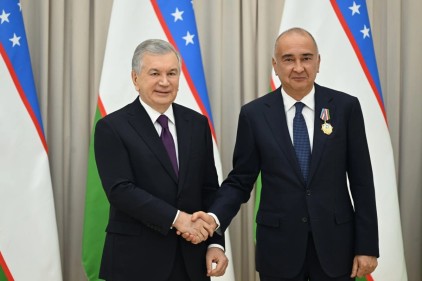
President Shavkat Mirziyoyev reviewed proposals for expanding Uzbekistan's network of small and micro hydropower plants Wednesday.
Under a resolution adopted last year, Uzbekistan plans to build around 3,000 small and micro hydropower plants with a combined capacity of 164 MW, with private-sector participation. So far, however, only 64 plants with a combined capacity of 41.6 MW have come online — roughly a quarter of the planned total.
Of the nearly 3,000 projects envisioned, developers have been identified for just 932. Progress has also lagged on tapping a $150 million concessional financing pool set up with World Bank support.
At the presentation, officials noted that entrepreneurs and investors still have concerns about the conditions for building plants and selling the electricity they generate.
To address this, officials proposed that auctions set not only a starting project cost but also a minimum tariff for electricity purchases, which would be adjusted based on a plant's capacity. The approach is intended to prevent a recurring problem: projects won at auction with "zero" bids that were never actually built. It should also make conditions for investors clearer and more predictable.
Design and construction of micro hydropower plants with a capacity of up to 100 kW will be shifted to a simplified regulatory track.
Plants under 50 kW would be exempted from urban planning review and state architectural and construction oversight. Developers would also be permitted to modify the structure of canals, rivers, and waterways to increase water pressure for power generation.
At water management facilities, small and micro hydropower plants built for internal use would be allowed to proceed without going through an auction process at all.
To support these projects, authorities plan to launch a digital platform covering the entire process — from identifying suitable sites to commissioning plants and managing their ongoing operation. A unified technical guide for designing, building, and operating small hydropower plants is also in the works, along with separate rules governing private-sector participation.
Heavy reliance on imports remains a persistent challenge for the sector: roughly 90% of hydro turbines and components for small and micro plants are currently sourced from abroad.
Officials pointed to the experience of Uzbekgidroenergo, the state hydropower company, which has already built 46 small and micro plants, as a model. The company's expertise could be leveraged to offer entrepreneurs end-to-end services — from design and construction to equipment supply.
A list of hydro turbines and components suitable for local production is also being drawn up, with related proposals to be presented to entrepreneurs and investors.
Uzbekistan's rivers and canals stretch more than 173,000 kilometers in total. Authorities believe there is untapped potential for small hydropower generation, particularly along concrete-lined canals, and have instructed relevant agencies to conduct a full inventory of such sites and identify new locations for future projects.
Uzbekistan aims to raise the installed capacity of its small and micro hydropower plants to 204.8 MW by 2030, with annual output reaching 620 million kWh. Officials say that would be enough to supply green electricity to around 350,000 households.
The expansion of small-scale hydropower is expected to save 187 million cubic meters of natural gas annually and prevent roughly 311,000 tons of carbon dioxide emissions each year.
Separately, starting with the new academic year, Uzbekistan plans to introduce a dual-education system to train specialists in small-scale green energy, with students completing internships at energy enterprises, including small hydropower facilities.
Mirziyoyev instructed officials to accelerate project implementation, expand private investor participation, make more efficient use of financial resources, localize equipment production, and step up training for specialists in the field.
Stay up to date with all the latest news: