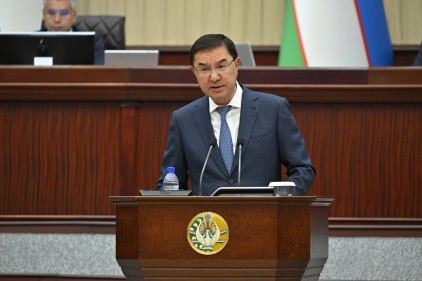
Uzbekistan is moving toward a more targeted approach to poverty reduction, one in which authorities work not just with statistical indicators but understand the situation of each individual low-income family and its members, Deputy Prime Minister and Minister of Economy and Finance Jamshid Kuchkarov said on August 25 at a session of the Legislative Chamber.
The session reviewed a government report on the implementation of the "Uzbekistan — 2030" strategy during the first half of the year.
Employment and Poverty Reduction Minister Botir Zakhidov told lawmakers that various income-boosting measures had reached 294,000 low-income families in the first six months of the year, far exceeding the initial target of 129,000.
According to the minister, 105,000 members of these families secured permanent jobs, roughly 25,000 were brought into entrepreneurship-support programs, and another 12,000 completed vocational training. Rising official incomes allowed 275,000 families to be removed from the social registry since the start of the year.
Commenting on these figures, Kuchkarov said President Shavkat Mirziyoyev had demanded a fundamental shift in how the government measures progress against poverty.
"In my report, I said the poverty rate had fallen from 5 percent to 4.5 percent. But the president raised a tougher question: don't fixate on percentages — behind those numbers, you've lost sight of the people," Kuchkarov said.
He pointed to the Khorezm region as an example. While the region's poverty rate looks relatively low in percentage terms, the deputy prime minister noted, it still represents roughly 81,000 people.
"Eighty-one thousand people — do you know who they are? What kind of help are they actually getting through those individual plans you keep referring to?" Kuchkarov said, relaying the questions the president had posed.
Following that exchange, officials from the economic bloc — including the employment minister and Central Bank leadership — traveled to the field to examine the situation of individual families, the minister said. Households in four mahallas within one district of the Khorezm region were surveyed as part of the review.
The findings showed that of the roughly 81,000 residents in the region classified as poor, about 59,000 fall into categories that cannot be directly drawn into employment — preschool- and school-age children, students, women with children under three, and pensioners.
Around 22,000 people, Kuchkarov said, are of working age. "They are the direct 'clients' of the Ministry of Employment — we need to be working with them," he said.
Of that group, about 12,000 are unemployed. Others are employed or self-employed, but per-capita household income still falls below the minimum subsistence threshold, keeping these families classified as low-income.
Kuchkarov stressed that the task now is to examine the circumstances of each family and each family member individually, rather than relying on aggregate figures for a region, district or mahalla.
"We shouldn't be fixated on percentages. We need to know, precisely, every poor family in every region, every district and every mahalla," he said, summarizing the tasks set before the government.
He added that an individual plan must look beyond adult employment alone. If a family has a child, officials need to understand how that child is doing in school, whether they attend sports clubs or extracurricular activities, and whether they are being left without opportunities available to other children.
"We have now been tasked with shifting our poverty-reduction work toward a targeted mechanism," Kuchkarov said, noting that the government is already conducting preparatory and analytical work to move toward this approach.
Earlier in his report, the deputy prime minister said government data showed Uzbekistan's poverty rate had fallen from 5 percent to 4.5 percent during the first half of the year. Around 300,000 income-boosting services were provided to 227,000 families listed in the social registry.
President Mirziyoyev unveiled a new poverty-reduction and employment system on September 3, following a two-week review of conditions in the Khorezm region, where officials analyzed the circumstances of 81,000 low-income residents across 19,000 families.
Under the plan, 3.2 trillion som will be allocated to districts, task forces will be formed under regional governors (hokims), and hokims will be given expanded authority over preferential lending, subsidies and interest-free loans. Hokims and members of the economic bloc will dedicate three days a week to poverty and employment issues.
Authorities also plan to intensify targeted support for children, women, pensioners and people with disabilities from low-income families, while tailoring business-financing terms to the specifics of individual projects and industries.