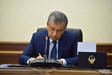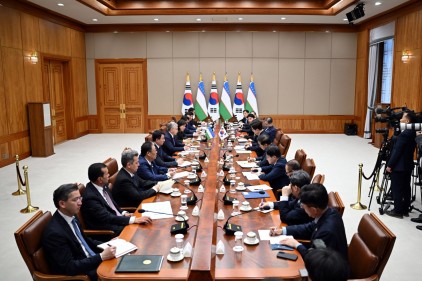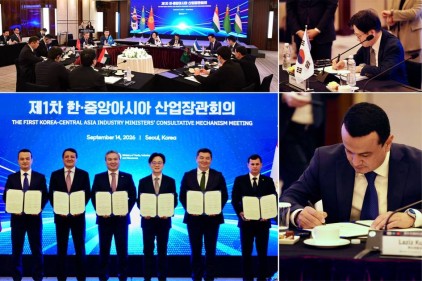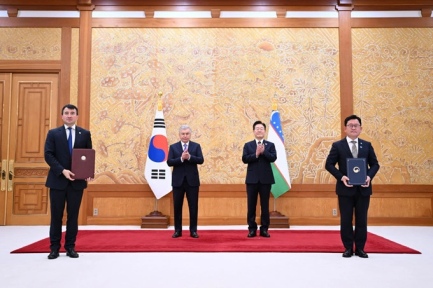
Presidents Shavkat Mirziyoyev and Lee Jae-myung witnessed a ceremony exchanging signed bilateral documents at the conclusion of talks in Seoul, the presidential press service reported.
The package included treaties and agreements aimed at deepening trade, economic, investment, and humanitarian cooperation. Among them were documents covering transport, aviation, agriculture, tourism, artificial intelligence, technical assistance, higher, secondary and preschool education, medical product regulation, ecology, climate change, intellectual property protection, and archival affairs, among other areas.
South Korea's Yonhap news agency reported that 13 interagency agreements and memorandums were signed in total.
Among them, the Export-Import Bank of Korea and the Ministry of Investments, Industry and Trade signed a memorandum establishing a mechanism to identify strategic projects. The document provides for identifying promising, mutually beneficial projects and examining opportunities for their project and commercial financing across six strategic sectors: critical minerals, data centers, smart cities, a special industrial zone for Korean companies, pharmaceuticals and biotechnology, and food, beauty, and content industries, according to the agency.
The South Korean president's office said earlier that the two countries intend to strengthen cooperation across the entire critical minerals supply chain — from exploration and extraction to processing — through the Korea-Uzbekistan Rare Metals Center.
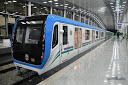
A memorandum was also signed on the delivery of eight high-speed trains and the establishment of a national genomics center and Biome Center biobank. The agreement is expected to expand cooperation between the two countries in transport and medical infrastructure. Yonhap reported that the scope of these projects could grow further, which would help Korean companies enter the market.
In June, Transport Minister Ilkhom Makhkamov said officials were considering modernizing the Tashkent-Andijan and Tashkent-Termez rail lines and deploying eight Hyundai Rotem high-speed electric trains on those routes.
On the biobank initiative, the Center for Advanced Technologies under the Ministry of Higher Education, Science and Innovation first announced such plans in October 2025. The project involves creating a genetic map of the population and a national biobank to support personalized medicine, drug development, diagnostic testing, and more accurate neonatal and prenatal screening programs.
Another memorandum between the two countries provides for strengthening cooperation on intellectual property protection at the border, including efforts to block the import of counterfeit goods bearing well-known brands.
The sides also signed a memorandum on cooperation in preschool and general education, aimed at expanding exchanges in preschool, primary, and secondary education. Korean language is set to be added as an official subject in Olympiad competitions organized by the government, a move expected to raise the language's profile domestically.
A memorandum on digital forest restoration and climate cooperation provides for jointly addressing cross-border environmental challenges in Central Asia, including desertification around the Aral Sea and disputes over water resources, as well as broader efforts to combat the climate crisis.
The two sides also signed memorandums on tourism cooperation to boost travel and people-to-people contacts, on agriculture involving the transfer of Korean agricultural technologies, and on cooperation in deploying artificial intelligence in industry and regulating medical products.
A document on expanding cooperation in the defense industry and a treaty on the transfer of sentenced persons were also signed.
Stay up to date with all the latest news: