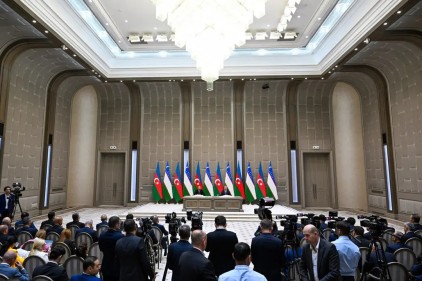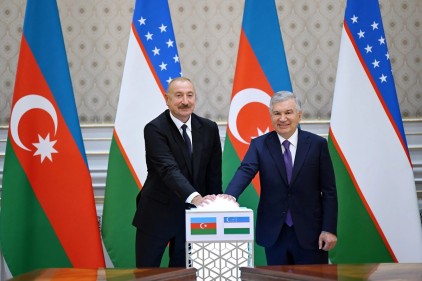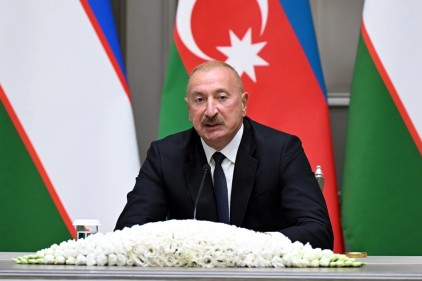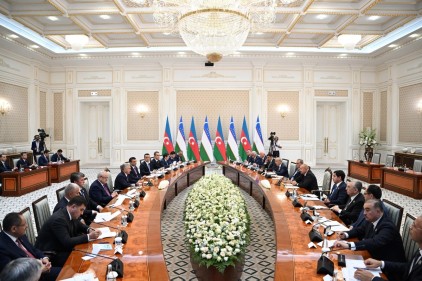
Uzbekistan and Azerbaijan have agreed to accelerate the creation of a joint fleet on the Caspian Sea, part of a broader push to deepen the Middle Corridor trade route linking Central Asia with Europe. President Shavkat Mirziyoyev announced the plan in a statement to reporters on August 23, following talks with Azerbaijani President Ilham Aliyev during the latter's state visit to Tashkent.
"We will jointly develop the potential of the Trans-Caspian corridor, improve the efficiency of our logistics infrastructure, and step up work on establishing a joint fleet in the Caspian Sea," Mirziyoyev said.
The announcement builds on groundwork laid earlier this year. Uzbek Deputy Minister of Investments, Industry and Trade Khurram Teshabayev said in July that Tashkent was planning a joint venture between the state freight operator Uztemiryulkargo and the Azerbaijan Caspian Shipping Company, known as ASCO. He said the initiatives were designed to improve the efficiency of multimodal transport, strengthen the resilience of supply chains, and cut logistics costs for exporters.
ASCO already operates the largest fleet on the Caspian, with 55 vessels including around 20 tankers, and has continued expanding capacity through new orders at the Baku Shipyard amid rising demand along the corridor. Analysts have described the planned joint venture as more than a routine commercial arrangement, framing it as a strategic move to synchronize Uzbek rail operations with Azerbaijani shipping and reduce the bureaucratic friction that has long slowed cross-Caspian trade.
The push for a joint fleet reflects fast-growing trade and transit volumes between the two countries. Transit freight between Uzbekistan and Azerbaijan reached 1.4 million tons in 2025, and volumes climbed a further 12.2% year-on-year in the first half of 2026, to 675,000 tons, according to figures Aliyev provided ahead of his visit. Aliyev said bilateral trade totaled $795 million in 2025, more than triple the previous year's level, with trade in the first five months of 2026 reaching $144 million, up 33% year-on-year. The two countries have set a target of raising annual trade turnover to $1 billion by 2030.
Both leaders also pointed to a developing green-energy corridor, with Azerbaijan, Kazakhstan and Uzbekistan exploring the transmission of wind and solar power across the Caspian toward Azerbaijan and, potentially, on to European markets. Aliyev additionally noted that the China-Kyrgyzstan-Uzbekistan railway now under construction could eventually link up with Middle Corridor routes running through the South Caucasus.
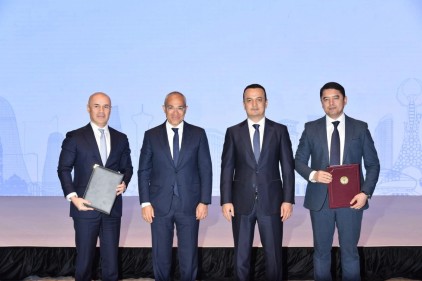
The Caspian fleet announcement came alongside a wider package of agreements signed during Aliyev's visit. Mirziyoyev and Aliyev signed a Treaty of Eternal Friendship, which Mirziyoyev described as reflecting a shared commitment to deepening cooperation and building a common future between the two nations. The two sides also signed agreements covering pensions, culture, tourism, cooperation between their foreign and justice ministries, and city-to-city partnerships pairing Urgench with Khankendi and Nakhchivan, and Bukhara with Lachin.
Mirziyoyev further pointed to the Investment Fund established several years ago as playing a key role in advancing joint industrial projects, and highlighted plans for a joint feature film on the literary legacies of Nizami Ganjavi and Alisher Navoi. The visit also comes as Uzbekistan and Azerbaijan prepare to jointly host the FIFA U-20 World Cup in 2027, following a 2025 FIFA Council decision, with Mirziyoyev unveiling a joint program called "Two Countries, One Championship" as part of preparations for the tournament.
"The scope and substance of our discussions show the scale and unprecedented momentum behind the Uzbekistan-Azerbaijan cooperation agenda," Mirziyoyev said, adding that the outcomes of the visit would open new horizons for joint projects and sustainable development between the two countries.
Stay up to date with all the latest news: