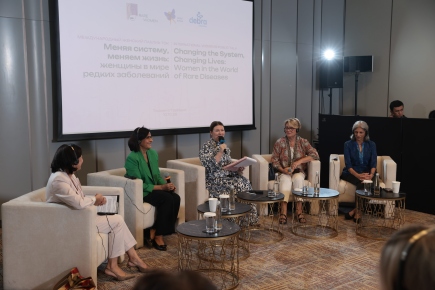
An international public talk, “Changing the system, changing lives: women in the world of rare diseases,” was held in Uzbekistan on Oct. 10, 2026. The event marked the fifth anniversary of Central Asia’s first genodermatosis unit, set up on the initiative of Alyona Yartseva (Kuratova), president of the autonomous non-profit Rare Women and founder of the Butterfly Children and Kapalak Bolalar foundations.
Participants from Uzbekistan, Russia, Singapore, India and Croatia discussed the role of women’s leadership in building support systems for people with rare diseases. The event brought together medical professionals, non-profit organizations, government bodies and international experts.
Opening the talk, Yartseva (Kuratova) reviewed the five-year journey and set out the main direction for the future: taking systemic work on rare diseases to the international level.
“Uzbekistan’s five years of experience allow us to gauge the broad social impact of the system we have built: better quality of life for patients and families, less social isolation, greater public awareness, and more opportunities for education and professional fulfilment. But most important, we see that this model works not only inside the country. Today we are joining forces with colleagues from Russia, Singapore, India and Croatia, and from many other countries, to make support systems for people with rare diseases accessible worldwide,” she said.
Yartseva (Kuratova) said this is especially symbolic ahead of 2028, which leaders of CIS countries proposed at a recent narrow-format meeting to declare the Year of Social Development in the CIS. Work on rare diseases is becoming part of a larger international agenda, she said, and the organizers are ready to share their experience and learn from partners.
The central theme was the role of women in developing support for people with rare diseases. Yartseva (Kuratova) said:
“This public talk is, above all, about women. It is usually they who take on the care of a child with a rare diagnosis, and often they who start to change things: setting up organizations, bringing other families together, pushing for decisions at the system level. But doing this alone is very hard. That is why exchanging experience between countries matters so much: when women leaders from different countries can talk to each other, offer support and say what worked and what didn’t.”
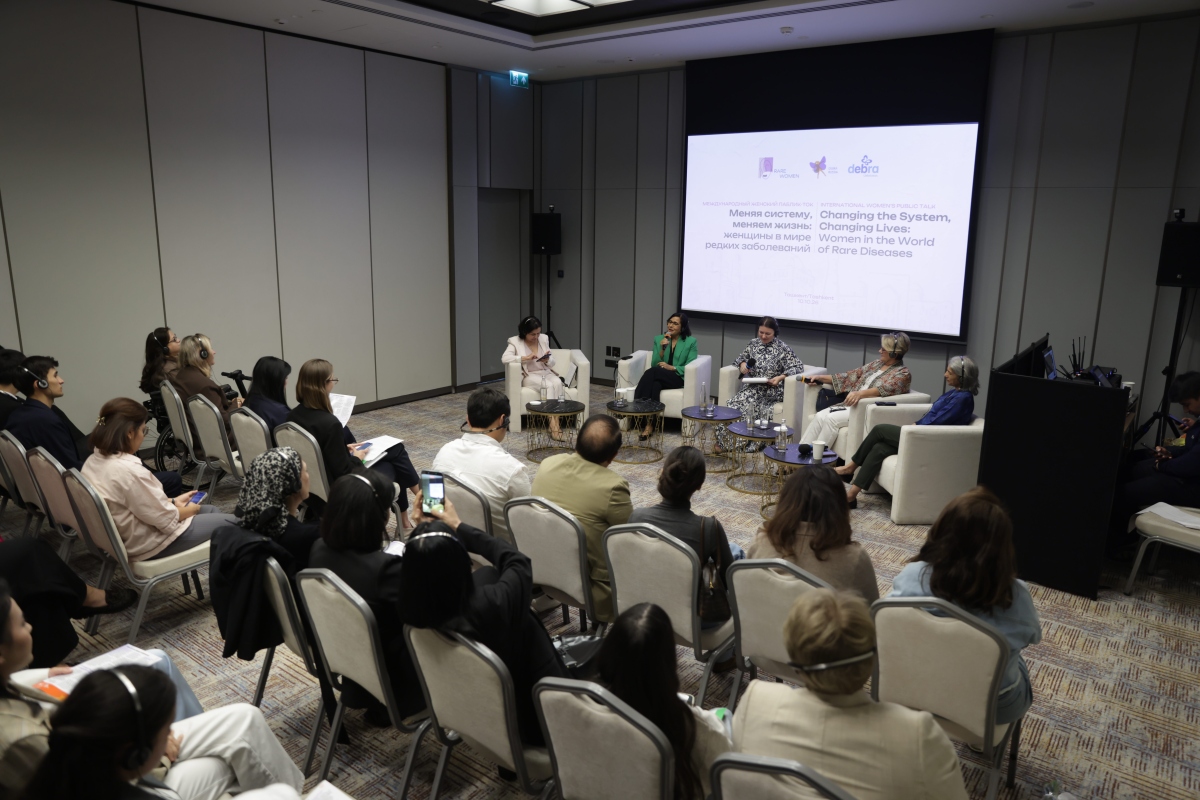
Ritu Jain, vice president of DEBRA International and president of DEBRA Singapore, described how patient organizations have grown from small mutual-aid groups into influential participants in public and government processes. Vlasta Zmazek, president of DEBRA Croatia, a member of the executive committee of DEBRA International and a board member of RareResourceNet, presented her organization’s 30-year experience as a partner to the state and the professional community. She said that membership in DEBRA International helps national organizations build expertise. Ratna Dua Puri, head and professor of the Institute of Medical Genetics and Genomics at Sir Ganga Ram Hospital in New Delhi, spoke about advances in genomic technologies, international practice in genetic diagnostics, training of doctors and the role of women scientists.
Guzal Jabbarova, chair of the Kapalak Bolalar foundation, shared Uzbekistan’s experience: how patients’ and families’ lives have changed over five years, and what opportunities open up for women when the system takes on part of the burden of care.
“Today we have built a system that works for everyone. The Center of Dermatovenereology gave enormous help: its specialists worked across the country, in every district, and Akram Rakhmatov spoke about epidermolysis bullosa in his lectures. Thanks to him, a checklist was produced, which we handed out in maternity hospitals, with instructions on which specialists to contact and what first aid should involve. All of this became possible thanks to a well-coordinated, large team,” Jabbarova said.
According to Akram Rakhmatov, a doctor of medical sciences and professor who heads the scientific laboratory for the study of mycoses at the Republican Specialized Scientific and Practical Medical Center of Dermatovenereology and Cosmetology under Uzbekistan’s Ministry of Health, which houses the genodermatosis unit, the state is actively involved in diagnosis, funding and rehabilitation of patients. Ten orphan diseases were designated last year, he said, and funding has risen 2.5-fold. The state now also pays for molecular genetic tests for certain forms of the disease, as well as therapeutic nutrition.
The talk closed with a general discussion, “Who are we creating change for?”, in which participants considered what changes for a person with a rare disease and their family when help becomes systemic and accessible. A key question was how to define the main measure of success: the number of services and institutions created, or real changes in people’s lives. Participants concluded that the main test of an effective support system should be whether a person can study, work, start a family and take part in society regardless of diagnosis.
Background
Rare Women brings together more than 1,000 members. Its work includes psychological support, career and professional development programs, further education, joint rehabilitation for mothers and children, medical consultations, specialized nannies and other forms of long-term support. The model has already been adapted for other non-profits: 11 charitable foundations and more than 500 new participants joined the Rare Women 2.0 project in 2024.
Kapalak Bolalar is a public organization that helps children and adults with rare genetic skin diseases in Uzbekistan. Its main work is supporting patients with epidermolysis bullosa, various forms of ichthyosis and other rare genodermatoses, and developing systemic medical and social care for them.