Much has changed in the country and in the Interior Ministry system over the past decade. But some old attitudes and patterns of behavior still make themselves felt. One example is a situation that sparked widespread discussion last week.
“Why do people speak badly of the police?”
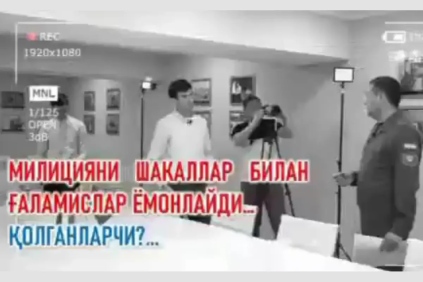
On Oct. 18, Kakhramon Khudoyberganov, spokesman to the Road Traffic Safety Department (RTSD) of Tashkent’s police Department (TPD), posted a video featuring Shokhrukh Giyasov, spokesman to the Interior Ministry. In it, a cameraman asks questions and Giyasov answers:
“Why does everyone on the street speak badly of the police?”
“Only jackals and ill-wishers speak badly of the police.”
“And everyone else?”
“Everyone else prays they never have to deal with them.”
The video is not new. It drew public and media attention, and criticism, several years ago.
Under the clip on Instagram, where Khudoyberganov has more than 2 million followers, many users criticized the two officials and expressed their disappointment.
“If you subtract from ‘all people’ those who ‘hate’ the police and those who ‘pray they never have to deal with them,’ you are left with zero,” one commenter wrote.
The video was not posted at random. It was a response to criticism directed at Khudoyberganov after another video featuring him, dated Oct. 16.
What outraged the public
In that video, the spokesman, two other law enforcement officers and an unidentified man hold a “preventive talk” with third- or fourth-grade pupils at School No. 183 in the capital. The traffic officer asks which children were driven to school in the front passenger seat. A boy and two girls raise their hands.
Khudoyberganov calls them to the board and asks their age (all are 9), their names and their fathers’ names. The children’s faces are not blurred. After they confirm they rode in the front seat, the TPD officer asks whether he should summon their parents to draw up administrative reports or forgive them. The class asks for forgiveness, and the children at the board promise not to do it again. They are told children under 12 may not sit in front.
The video was viewed more than 7.7 million times in its first 24 hours. Many users condemned the traffic department spokesman’s actions.
Violation of children’s rights and interests
The Ministry of Education and Science said that the TPD's visit to the school had not been agreed in advance. It added that the “talk” took place after classes. The ministry said such actions could violate children’s rights and frighten them.
Children’s ombudsman Surayo Rakhmonova said that circulating such videos is not consistent with laws protecting children’s rights.
“Questioning a child, even if their parents are breaking traffic rules or committing other unlawful acts, filming them and distributing the footage publicly without the permission of the child’s legal guardian runs counter to the child’s interests,” she said.
“Under no circumstances is a child responsible for the misdeeds of their parents. Putting a child in an awkward position in front of many peers can cause anxiety, embarrassment and, to a degree, humiliation,” the ombudsman said.
Rakhmonova added that raising children’s awareness is necessary, but such events must respect the child’s dignity and inviolability, without discrimination or stigmatization.