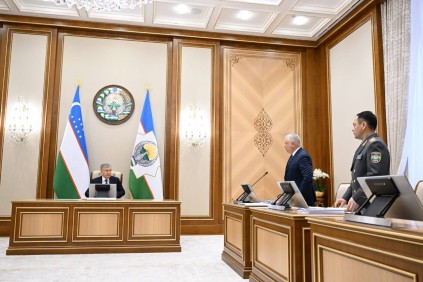
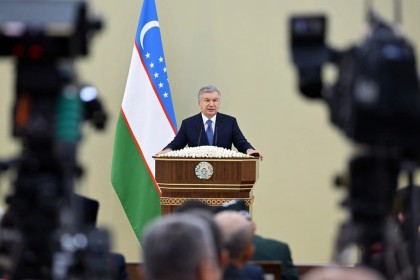
President Shavkat Mirziyoyev was presented with draft state program for implementing the Uzbekistan 2030 Strategy in 2026, the presidential press service said.
The reform programs include initiatives put forward by the president in his address to the nation and the parliament, as well as the highest-priority reforms for 2026. These include: improving neighbourhoods’ infrastructure, transitioning the economy to a technological growth model, stimulating domestic demand, professional development and creating a new labor market architecture, ensuring environmental balance and organizing the rational use of water resources, improving public administration and the judicial and legal system, and ensuring social unity.
The program envisages a shift from the principle of "document development" to "results achievement": implementation mechanisms and KPIs have been outlined for each initiative, and responsible officials and coordinating bodies have been identified.
The State Program for Implementation of the Uzbekistan-2030 Strategy during the Year of Development of the Neighbourhood and Society will organize the implementation of the strategy's target figures for 2026. Fifty-nine drafts of key regulatory legal acts in this area and 12 drafts of regulatory legal acts providing for key strategic reforms will be developed.
Reportedly, "special attention was paid to public opinion during the development of the drafts." The State Program was posted for public input, and information about it was distributed through the media and online from January 23 to February 1. More than 5 million users viewed the draft online, expressing over 22,000 opinions and suggestions.
Following the review, nearly 1,000 proposals were selected and deemed constructive and included in the draft State Program.
In particular, support was given to initiatives such as toughening penalties for violence against women and children, introducing life imprisonment for pedophilia, improving credit mechanisms for mortgages and electric vehicle purchases, increasing the share of renewable energy sources to 30%, taking anti-corruption efforts to a new level, and introducing jury trials in criminal proceedings.
Furthermore, proposals such as strengthening transparent accountability for the spending of funds allocated for mahalla needs, building roads, pedestrian and bicycle paths within mahallas, creating business incubators, opening professional retraining centers in industrial zones, increasing penalties for tree felling, introducing energy efficiency KPIs, and establishing recycling and recycling chains were "considered interesting."
The draft state program was also discussed with Uzbeks in the United States, Germany, Turkey, France, Canada, Korea, Japan, Sweden, Portugal, and Kazakhstan, with approximately 60 proposals received. Compatriots abroad made proposals such as implementing transparent licensing and oversight mechanisms for the development of private schools, implementing an incentive system for enterprise specialists supervising interns, implementing a unified digital screening system to identify risk groups for cervical and breast cancer, introducing a performance-based subsidy model for providing preferential loans, implementing an "Export-as-a-Service" model for exporting companies, providing comprehensive logistics, customs, certification, marketing, and payment services through a single operator, and preparing instructions and video guides for managing the electronic queue for lawyers.
A total of 250.5 trillion soums and $50.4 billion are earmarked for funding these programs.
Responsible officials assigned to each reform program will report quarterly to the president on the progress of implementation. The Prime Minister has been tasked with strict oversight of their implementation.
After reviewing the submitted projects in detail, Shavkat Mirziyoyev approved the reform programs and the state program for Year of Development of the Mahalla and Society by signing the respective decree. He emphasized that all reforms must, above all, ensure tangible results in people's lives, resulting in the creation of new jobs, increased incomes, and improved public satisfaction.