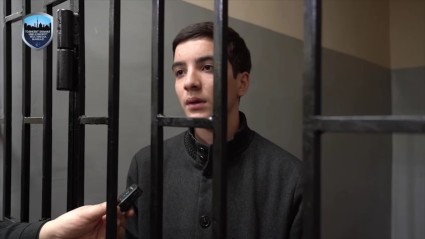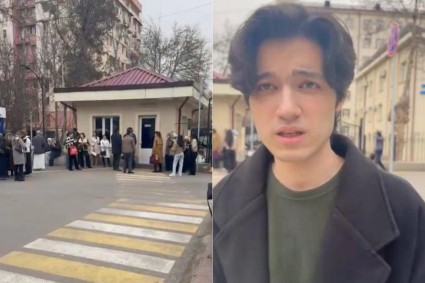
Akmal Yuldashev, a first-year graduate student at the University of Journalism and Mass Communications complained that he had not been allowed into classes for not complying with the university’s dress code, which includes wearing a tie. His interview, published Monday by Bakhodirkhon Eliboev, sparked a new debate about the need for uniforms in universities.
"I was not allowed in because I didn't have a tie," the student says in the video footage. "No one asked me if I studied well, whether I attended lectures, or whether I read literature. If you don't have a tie, back off. These are internal rules, they prevail over everything else. If you comply with the dress code, you'll get in. Despite everything, my classmates and younger students are standing here hoping that we'll finally be allowed in."
When asked about his attitude toward university uniforms, Akmal Yuldashev said, "Negatively. Because my appearance doesn't determine my knowledge, my competencies, or how talented I am to become a journalist."
"I come to the university, and the university provides me with services. We have a contract for that. I've paid, I'm supposed to attend lectures, I'm supposed to participate in seminars, my knowledge is supposed to be assessed, and at the end, I'm supposed to receive a diploma," the student emphasized.
"Right now, due to some internal regulations, my rights as a consumer, my rights as a student, are being violated. I come to learn something, not to show off my tie, not to hear someone say that everyone at our university should wears ties," he continued.
"They are not treating me as a student, if they did so, they would happily open the doors for me. But they treat me not like a student, but like some kind of social object, like an object of comparison with other institutes and universities. Look, our student is wearing a tie. If they treated me like a student, I'd be sitting in a classroom right now," he added.
On social media, users likened the dress code to an attempt to restrict the freedom of future journalists. Some emphasized that Akmal Yuldashev expressed healthier ideas than some of his administrators.
"Internal rules are not something to be discussed."
Oisha Zakirova, dean of the University of Journalism, posted a reaction to the student's video interview on Facebook but soon deleted the post.
"Monday is the beginning of a new academic week. However, unfortunately, some undergraduate and graduate students have shown disrespect for the university's internal rules. A university is more than just an educational institution. It is an intellectual environment, a school of education, a place where professional identities are formed. Internal rules are established not for discussion, but for implementation, and everyone adheres to them equally! They serve to shape the image of each organization! A white shirt and tie are symbols of academic culture, purity, discipline, and respect. What's wrong with wearing them?!" she wrote.
Oisha Zakirova stated that, as dean, she was personally responsible for the university's image, ethos, and order.
"Therefore, there can be no concessions when it comes to adhering to internal rules. Simple discipline and internal order are the fundamental conditions for reform. Moreover, putting the university where you study on public display, tarnishing its reputation over a simple, basic requirement, is like spitting in the plate you eat from. Don't forget this, dear students!" the dean wrote.
She later added that a journalist had the right to dress according to the rules of the organization where she works, or according to her personal preferences. But every student studying at the university must abide by its internal rules! Moreover, all the students shown in the video were not allowed into classes because they were late, not because they showed up without uniform," Oisha Zakirova stated.
The Ministry of Higher Education, Science, and Innovation said that universities have the right to impose a dress code.
"Each higher education institution has the right to set up requirements for student appearance and dress codes based on its internal regulations and code of ethics. These regulations are approved by the university council and are mandatory for all students," a ministry spokesperson stated.
The ministry did not express a position on the student's video interview.