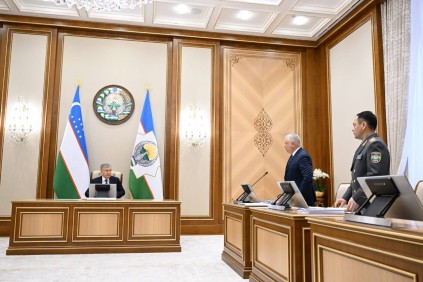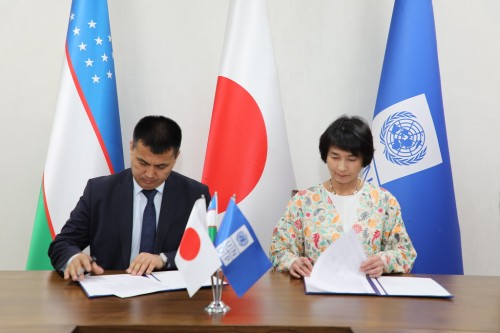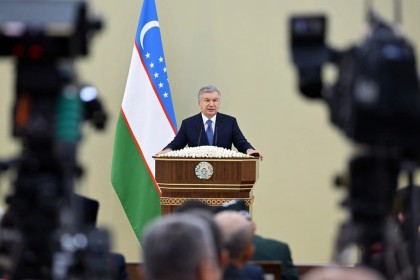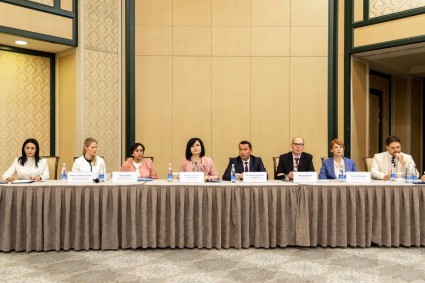
The Ministry of Primary and Secondary Education (MoPSE), the United Nations Children's Fund (UNICEF) and Cambridge University Press & Assessment (Cambridge) are working together to reform Curriculum for Primary and Secondary. This week, they step up efforts as they roll out a series of training workshops across Uzbekistan.
A bold bid to improve quality across Uzbekistan’s education sector, the curriculum reform is a main priority under the SmartEd Project. The project is funded by the Islamic Development Bank (IsDB), the Arab Coordination Group (AGC), the Global Partnership on Education (GPE), and implemented jointly by MOPSE and UNICEF together with Cambridge.
The reform tackles a dual challenge: ensuring all learners build foundations like good literacy and numeracy, and equipping them with the knowledge and skills they need for the future.
“Uzbekistan's education reform is about creating a quality, reliable, inclusive, and modern education system for the new generation. In improving curricula, special attention is paid to the principles of competency-based education, gender equality, inclusion, socio-emotional education, as well as climate change and environmental responsibility, and the development of technological and digital literacy”, said Dilshoda Norbaeva, a.i. Director of Republican Education Center.
The current reform has seen online and face to face workshops that bring together international experts, local senior educators, researchers, trainers and teaching practitioners in all subjects. It is the beginning of a strong push by the Uzbekistan government to improve learning outcomes, enable successful transitions to life and work, while also making Uzbek students competitive against the best international standards.
“A modernized curriculum should strengthen foundational skills such as literacy, numeracy, and socio-emotional competencies, these are essential building blocks for all future learning,“ said UNICEF Representative Ms. Regina Castillo. “At the same time, we hope that the reform will integrate 21st-century skills—critical thinking, creativity, problem-solving, digital literacy, and collaboration—that are increasingly necessary for success in a rapidly changing world.”
In an unprecedented approach to curriculum reform, MoPSE has ambitions to build on Uzbekistan’s rich education approaches and align these with curriculum content and assessments of high-attaining education systems internationally. Furthermore, for the first time, the process of curriculum revision is underpinned by robust analysis and a clear roadmap with shared understanding of expectations in comparison to high-attaining education systems.
The curriculum reform relates to all phases of education, from Pre-School Level upwards, in line with Resolution CM 157, which sets out the process and quality assurance criteria for the development of educational standards. It will be based on extensive co-creation and consultation with education stakeholders and teachers.
Building on best international expertise and practices, this is the first time in a curriculum review process that every single subject team is supported by strong international subject experts, who will be working together with the team regularly throughout the year to complete full curriculum revision. While there was engagement of international experts in the curriculum development process previously, this never covered all subjects and all grades and has never been such a deep co-creation process.
Steve King, Head of Education Reform, Europe, Central Asia and the Americas, Partnership for Education, Cambridge said: “Working with partners across Uzbekistan, I’ve seen a nation whose drive for progress is matched by a determination to do it right and a very long history of scholarship and learning. The vision of an education system in Uzbekistan that has a world class curriculum, assessed by fair, reliable and internationally recognized exams, and taught by well-trained, qualified, highly skilled teachers is achievable and within reach.”
This week, Cambridge curriculum experts will run a two-day workshop for subject leads. This workshop will focus on ensuring the different subject curricula align with one another. Leads will also look at how the curriculum embeds key themes, which include climate education and green education, social and emotional learning, wellness and life skills. Through collaboration, participants will share best practices and address contextual challenges, driving high quality curriculum development across Uzbekistan. In further workshops, subject specialists will explore how to align curriculum content with agreed standards. For example, international A-level standards and the national curriculum and assessment model. Future workshops will also focus on continuing to develop clear, high‑quality curriculum content across all grades.
Once finalized and implemented, the impact will be transformative reaching 8.8 million learners from preschool and school annually, including those who have additional needs due to disability, different ethnic and social-economic backgrounds. The impact is a curriculum which supports cognitive, social and emotional development and prepares pupils for life and work in a rapidly changing world.