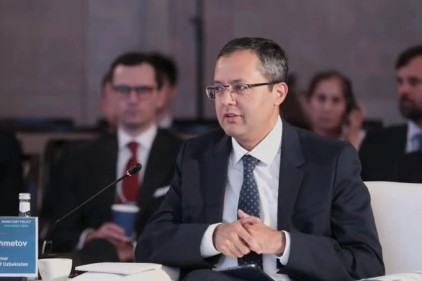
Uzbekistan’s transition to inflation targeting has been a "game-changer" for the country, completely transforming its monetary policy framework. Timur Ishmetov, governor of the Central Bank, made this declaration on June 29 at the Monetary Policy Dialogue – 2026 in Tashkent.
According to Ishmetov, anchoring the long-term inflation target at 5% has significantly strengthened the Central Bank's analytical capacity, improved its forecasting, and sharpened its communication strategy.
"The results speak for themselves: inflation has plummeted from 20% in early 2018 to 10% in 2023, reaching 5.5% this past May. Core inflation has also dropped to 5.7%," he noted.
The Central Bank chief highlighted that another clear sign of progress is the halving of inflation expectations, which fell from 20% down to 10%. However, he admitted that when it comes to shifting public perception, "there is still room for improvement."
"We need to keep working on this. Nonetheless, we believe that such a substantial shift demonstrates that we are earning public trust," the head of the regulator emphasized.
He pointed out that inflation targeting should not be treated merely as a numbers game. For the Central Bank, observing tangible changes in the behavior of everyday citizens and businesses is equally critical.
As a primary indicator of this growing trust, Ishmetov pointed to the dedollarization of the economy—specifically, the shrinking share of foreign currency deposits and loans. Since 2018, dollarization in deposits fell from 41.2% to 20%, while loan dollarization dropped from 54.3% to 37.4%.
"Our research shows that these are not merely technical adjustments, but genuine structural shifts that reflect the strengthening role of our national currency. Households and corporate entities increasingly prefer to operate, hold deposits, and settle transactions in the local currency," Ishmetov stated.
The Central Bank governor concluded by emphasizing that ongoing structural reforms bring unique challenges to monetary policy. He noted that the future trajectory of inflation will heavily depend on the pace of these reforms and the degree of alignment with fiscal policy.
"Predictability and policy coordination can significantly lower the economic costs of disinflation. This is absolutely vital for developing economies navigating structural reforms," Ishmetov noted.
The Central Bank governor also emphasized that central banks must continuously modernize to ensure their policy tools remain effective. In Uzbekistan’s case, he explained, it is crucial to strengthen monetary policy transmission mechanisms so that regulatory decisions directly influence market interest rates, consumer savings habits, and lending conditions.
Among the key priorities, he highlighted deepening the financial market and sustaining the ongoing overhaul of the banking sector.
Ishmetov specifically focused on the vital role of the exchange rate. For a small, open economy, he remarked, a flexible exchange rate serves as a critical buffer against external shocks. "Maintaining this flexibility is essential for us, and a fully floating exchange rate will ultimately anchor our inflation-targeting framework," he declared.
Adapting to today's macroeconomic landscape requires central banks to remain strictly disciplined in their targets while staying flexible in their responses, depending on the pace of reforms and the shifting economic climate. However, he added, maintaining total transparency is paramount so market participants remain confident in the regulator's structural discipline.
"Earning trust is best achieved during precisely these types of transitional periods," he concluded.
During the panel discussion, Ishmetov wrapped up by noting that over the nearly nine years of reforms in Uzbekistan, and since the global adoption of inflation targeting, the world has experienced profound changes—and that transformation shows no signs of slowing down.
According to Ishmetov, one of the key lessons for Uzbekistan is that while monetary policy must remain firmly committed to its specific target, the bank must pay closer attention to alternative economic scenarios.
"Instead of focusing entirely on hitting the inflation target itself, perhaps we now need to analyze what the worst-case scenario looks like, or what negative ripple effects could emerge under different conditions," he noted.
The Central Bank governor emphasized that alongside the primary objective of price stability, it is imperative to place a stronger focus on the overall resilience and durability of the financial system.
"We must ensure that even under the worst-case scenarios, we remain resilient enough to weather the storm with minimal damage. At the same time, our target must serve as our main anchor, and we must continue moving steadily in that direction," Timur Ishmetov said.
He further explained that given the ongoing reforms and their accompanying challenges, focusing on scenario-based resilience is particularly crucial for Uzbekistan. The regulator cannot afford to deviate significantly from its path because, as he put it, "in the real world, any scenario can materialize."
Ishmetov previously stated that the Central Bank sees "no significant obstacles" to bringing inflation down to its 5% target by 2027. While acknowledging that the timeline for hitting this milestone had been pushed back multiple times in the past, he cited high domestic demand, fiscal spending exceeding budget projections, and several other factors as ongoing risks.
Stay up to date with all the latest news: