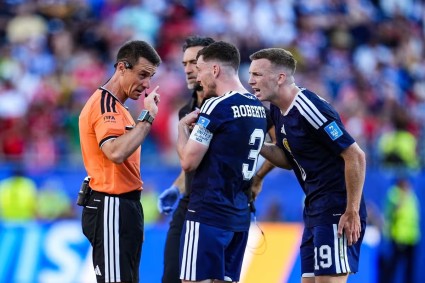
In the hyper-sanitized era of modern football, a dangerous precedent has taken over the pitch. We have all grown accustomed to the theater: a player feels the slightest whisper of a defender's breath, crumples to the grass in simulated agony, and inevitably draws a whistle. The beautiful game has increasingly become a non-contact sport governed by fragile sensibilities.
But in Boston, during a grueling World Cup clash between Scotland and Morocco, one man decided he had seen enough. That man was Uzbek referee Ilgiz Tantashev.
A Vintage Performance in a Modern Era
From the opening whistle, it was clear Tantashev wasn’t interested in the modern theatrics of diving and soft fouls. When Morocco’s Issa Diop felled Scotland’s Che Adams in the first half, Scottish pundits cried out for a red card. When John McGinn and Scott McTominay went down in the box during the second half, the modern textbook screamed "penalty." Former referee Christina Unkel even chimed in on ITV, dissecting minimal knee contact and steps on boots, arguing that "you don't need a lot to give a penalty."
But Tantashev refused to buy into the softness. He let the game flow. He tolerated a high level of physical, robust contact, letting the players actually compete rather than letting the whistle dictate the rhythm of the match.
Predictably, the frustration from the Scottish side was palpable. Head coach Steve Clarke grumbled about "one or two decisions," and players felt aggrieved. They were shocked because they are used to a modern system that rewards the soft fall. They expected the referee to protect them from the harsh reality of 50-50 challenges. Tantashev, however, demanded they stand on their own two feet.
"A Perfectly Normal Referee—10 Years Ago"
While modern pundits debated the minutiae of the penalty claims, former Scotland winger Pat Nevin saw exactly what Tantashev was doing, and he couldn't help but admire it. Defending what others called a "bizarre" refereeing display, Nevin cut through the noise with a truth that resonates with every purist of the game.
"You put that referee in a game 10 years ago and he's perfectly normal," Nevin stated. "I'm all right with that. He made a couple of mistakes but, in reality, I'd rather have him than most of the referees we get these days. We'd have a much more robust game where not every single time somebody nudged somebody and that person crumpled, it's a foul."
Nevin’s words captured the soul of Tantashev’s officiating philosophy. The Uzbek referee brought back the grit, the masculinity, and the unyielding toughness that originally made football the world’s game. He reminded everyone that a nudge is just a nudge, and going to ground should be a consequence of gravity and force, not tactical choreography.
The Lesson from Tashkent
Even Scotland's John McGinn, despite his frustration over not getting a penalty call, ultimately had to respect the reality Tantashev forced upon the pitch. "We need to be better and create chances from open play, not rely on referee's decisions," McGinn admitted after the match.
By refusing to whistle for every theatrical tumble, Tantashev did something revolutionary for modern football: he forced the players to stop looking for handouts from the official. On a night of incredibly fine margins in Boston, Morocco took their 1-0 victory, but the real story was the man from Uzbekistan who stood tall in the center circle. Ilgiz Tantashev didn't just referee a match; he single-handedly brought manhood and old-school resilience back to the World Cup stage.
Ravshan Irmatov's Legacy
Ravshan Irmatov (born in Tashkent) holds the all-time World Cup record for the most matches officiated by a single referee in tournament history.
He was named the best referee in Asia five times and won the Global Soccer Award for Best Referee of the Year.
No-Nonsense Style: Irmatov's "manhood" or strength of character was shown in how he handled the intense physicality of high-stakes matches. Rather than over-relying on cards for minor scuffles or letting games devolve into diving and dissent, he established deep respect on the pitch through calm authority and exact rule enforcement.