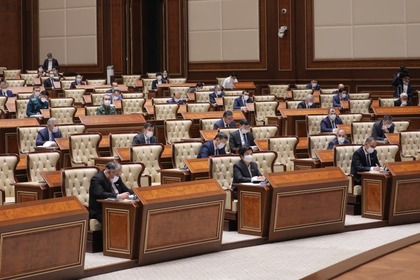
During its plenary session on June 2, 2026, the Legislative Chamber of the Oliy Majlis reviewed and passed the draft constitutional Tashkent International Financial Center Bill and the International Center for Digital Technologies Bill in their second reading, forwarding both bills to the Senate for final approval.
The Tashkent International Financial Center bill has proposed critical amendments and additions to the Constitution of the Republic of Uzbekistan, as well as several other legislative acts.
Specifically, a new clause proposed to be added to Article 15 of the Constitution establishes that while a unified legal space must be maintained across the territory of the Republic of Uzbekistan, special legal regimes may be instituted in designated zones by statutory law.
An addition to Article 131 of the Constitution stipulates that specialized courts may be established within the territories operating under these special legal regimes.
Furthermore, an amendment to Article 134 of the Constitution cements the provision that under certain extraordinary circumstances, judicial jurisdiction and the rules of legal procedure may be independently regulated by specific legislation.
The constitutional bill explicitly defines the legal status, operational principles, governance framework, and regulatory powers of the Tashkent International Financial Center, alongside the parameters of the special legal regime that will govern its territory.
Specifically, the framework incorporates provisions allowing the principles, statutory legislation, and judicial precedents of English Common Law (the law of England and Wales) to apply within the center's territory, provided they do not conflict with the Constitution of the Republic of Uzbekistan, this constitutional law, or the official resolutions of the financial center itself.
During the parliamentary session, lawmakers emphasized that the experience of the world's leading financial hubs—such as the Dubai International Financial Center (DIFC), the Astana International Financial Center (AIFC), and Singapore—had been thoroughly analyzed to establish the institutional blueprint for the Tashkent International Financial Center.
The bill solidifies the distinct legal statuses of the Tashkent International Financial Center Authority, the Tashkent Financial Services Regulatory Authority, and the Tashkent International Commercial Court. Under this architecture, the Financial Services Regulatory Authority will hold sweeping powers over corporate licensing, regulatory oversight, and enforcement actions. Meanwhile, the Tashkent International Commercial Court will serve as a fully independent judicial body to adjudicate disputes between center participants.
Furthermore, the bill grants center participants and their personnel the right to execute transactions directly in foreign currencies, hire international specialists seamlessly, and secure specialized multi-year visas valid for up to 5 years. A generous package of targeted tax exemptions and customs incentives will also be enforced within the designated territory.
The constitutional International Center for Digital Technologies bill provides for the creation of a special legal regime within the hub's territory. Specifically, it aims to streamline registration, licensing, and business procedures, while adopting global standards to regulate commercial transactions.
The bill also proposes a highly flexible tax and customs framework. Notably, this includes exemptions from specific taxes for certain business activities until the year 2100, alongside expedited clearance procedures for importing equipment, technology, and hardware.
According to the bill, the operations of the International Center for Digital Technologies will be governed by a specialized legal framework rooted in the Constitution of the Republic of Uzbekistan. This structure will incorporate elements of English Common Law (the law of England and Wales) and regulatory standards modeled after the world's leading international financial hubs.
The legislation also introduces robust support mechanisms for hub participants, including the establishment of a centralized one-stop-shop for corporate registration and administrative services, guaranteed protections for intellectual property and capital investments, and clearly defined channels for interacting with state authorities.
During the preparation of the bill for its second reading, several clarifying amendments were integrated. To fortify information security within the IT hub's jurisdiction, the updated text enforces strict requirements to ensure data security, integrity, protection, and reliability whenever cloud computing technologies are utilized, alongside guaranteed parameters for data processing and accessibility.
Both constitutional bills were passed by the lower house and have been forwarded to the Senate for final approval.
Stay up to date with all the latest news: