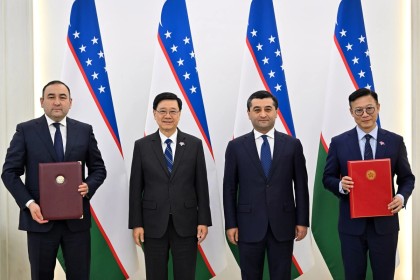
Uzbekistan and the Hong Kong Special Administrative Region of the People's Republic of China have exchanged verbal notes expressing their intent to conclude an intergovernmental agreement on mutual visa-free travel. The exchange took place during a visit to Tashkent by Hong Kong's Chief Executive John Lee Ka-chiu.
Uzbekistan's Foreign Minister Bakhtiyor Saidov, who held talks with John Lee Ka-chiu, expressed confidence that "this step will create additional opportunities for the development of business, tourism, and humanitarian exchanges, and will also contribute to bringing the peoples of our countries closer together."
The talks covered promising areas of cooperation in investment, finance, digital transformation, artificial intelligence, transport, and logistics. The minister noted that the two sides also gave separate consideration to expanding interregional cooperation, strengthening direct ties between business communities, and advancing new joint initiatives.
"Hong Kong's unique experience and tremendous potential as one of the world's leading international financial and business hubs can make a meaningful contribution to the modernization of Uzbekistan's economy and the implementation of joint high-tech projects," Bakhtiyor Saidov added.
On Facebook, John Lee Ka-chiu clarified that the visa-free arrangement is planned for stays of up to 30 days, and noted that both sides intend to work toward putting the agreement into effect as soon as possible.
Hong Kong's Chief Executive also expressed confidence that lifting visa requirements for short-term visits would boost tourism, education, and business ties, while laying the groundwork for long-term economic and trade exchanges.
Currently, Hong Kong passport holders can visit Uzbekistan visa-free for up to 10 days, while Uzbek citizens are required to obtain a visa to enter Hong Kong. Holders of diplomatic and official passports are exempt from this requirement for stays of up to 14 days.
As of June 1, 2025, a 30-day visa-free arrangement has been in effect between Uzbekistan and China — though it does not cover employment, study, or media activities.
Stay up to date with all the latest news: