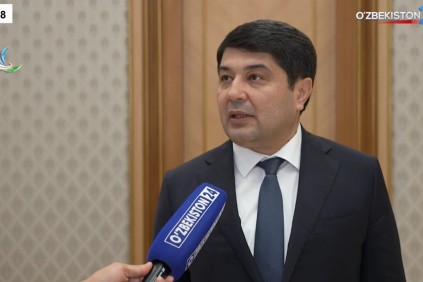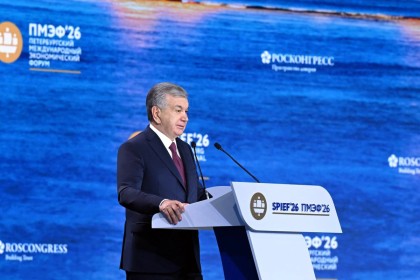
Russia is more than just a regional neighbor to Uzbekistan. "Russia is our time-tested strategic partner and ally," declared President Shavkat Mirziyoyev at the St. Petersburg International Economic Forum on Friday.
"Today, our relations have entered a new era. Our cooperation has become multi-tiered and multi-faceted. We have evolved from basic commodity trading to establishing complex industrial supply chains, technological alliances, joint engineering ventures, and localized production," he underscored.
To illustrate his point, the President shared recent data: over the past decade, bilateral trade volume has more than tripled, surging from $4 billion to $13 billion. The current portfolio of joint ventures with Russia exceeds $50 billion. Deep cooperation has also been established at the provinces level, where active inter-provinces projects currently account for $5 billion, with an additional $5 billion investment package on the horizon. Furthermore, joint industrial parks are currently operating across five regions of Uzbekistan, and a dedicated railcar manufacturing cluster has been established in Tashkent.
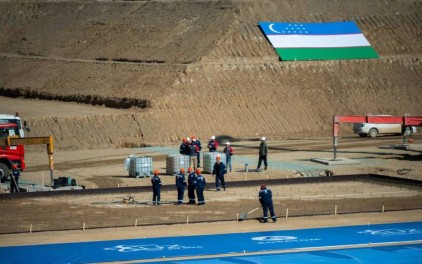
The crown jewel of this cooperation will be the nation's first hybrid nuclear power plant, currently under construction in the Jizzakh province with Russian participation. "For us, this is a project for long-term development—one that will train a new generation of engineers and help us master cutting-edge technologies," Shavkat Mirziyoyev emphasized.
"We intend to work together across other peaceful applications of nuclear energy as well, including medicine, agriculture, industry, and scientific research," he added.
In his address, the President of Uzbekistan proposed a series of joint initiatives.
He emphasized that technological and industrial cooperation between Uzbekistan and Russia must expand beyond a strictly bilateral framework.
"We are targeting vast areas of cooperation that can integrate industrial capacity, resources, markets, and expertise. To this end, we propose the creation of a 'Eurasian Belt of Technological Industrialization,'" he announced.
This initiative envisions a system of interconnected manufacturing and technological clusters linked by a unified digital platform for industrial cooperation. The goal is to build full-cycle supply chains—spanning from technology development and talent training to localized manufacturing and expanding into external markets.
Shavkat Mirziyoyev suggested launching this initiative using the foundation of the "Innoprom. Central Asia" international industrial exhibition, which is hosted annually in Tashkent.
Another highly promising avenue for collaboration is digitalization, which the President noted "is becoming the new language of the economy."
"While infrastructure used to mean roads, pipelines, and power lines, today it primarily means digital platforms. These platforms build an entire ecosystem around themselves, creating jobs, logistics networks, payment services, and fresh export opportunities," the President stated.
He shared that the volume of goods sold by Uzbek merchants through Russian marketplaces and digital services has surged 3.5 times over the last few years, surpassing $1.5 billion.
To deepen this cooperation, he proposed taking steps toward a shared Digital Ecosystem: "As a starting point, this could include aligning regulations for digital trade and urban services, further promoting Uzbek and Russian brands on each other's platforms, creating a unified digital employment profile, and developing AI-based products. This approach will open up new markets for businesses and unlock additional income opportunities for citizens."
"In our pursuit of digitalization, it is vital to remember that people are always at the heart of any transformation," Shavkat Mirziyoyev continued.
He highlighted the significant role bilateral cooperation plays in education and professional training. Uzbekistan currently hosts the largest network of Russian university branches anywhere in the world, accounting for 15 out of the 32 foreign university campuses operating in the country.
The President proposed launching specialized online learning services to enable young people, even those in remote areas, to acquire essential skills. This initiative aims to "fundamentally reshape the labor mobility model and elevate its management to a qualitatively new level."
To achieve this, Uzbekistan proposes creating a joint Online Human Capital Development Platform designed to "bridge the gap between education, professional training, and the job market." Shavkat Mirziyoyev explained that this system could integrate academic programs, language and IT courses, support initiatives for young entrepreneurs, and direct pathways to employers.
"For our youth, this will provide a clear roadmap into the new economy. For businesses, it offers immediate access to a pool of skilled talent. For universities and colleges, it creates a direct link to real market demand. Ultimately, for both Uzbekistan and Russia, this represents a long-term investment in our highest value—human potential," he noted.
The "Samarkand to St. Petersburg" Creative Tourism Corridor
The President Mirziyoyev separately emphasized tourism as the "humanitarian foundation of our partnership."
"This industry is unparalleled in its ability to build an economy of trust. When people visit Uzbekistan, they do not just see monuments and ancient cities—they experience our culture, hospitality, business environment, and investment opportunities," he said.
In 2025, nearly 1 million Russian tourists visited Uzbekistan, with an even higher turnout expected this year.
The country is actively developing its creative economy alongside standard tourism infrastructure. By 2030, the creative sector is projected to account for 5% of the national GDP, "transforming this creative field into a primary driver of economic growth."
To capitalize on this momentum, Shavkat Mirziyoyev proposed launching the "Samarkand to St. Petersburg" Creative Tourism Corridor.
"This initiative envisions organizing joint art and film festivals, museum exhibitions, culinary weeks, and major musical events," he explained.
Stay up to date with all the latest news: