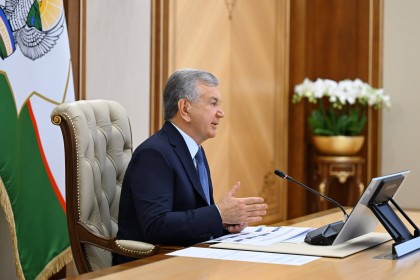
President Shavkat Mirziyoyev has reviewed a presentation on implementing digital solutions and artificial intelligence technologies across the mining and geology sectors.
The mining industry plays a pivotal role in the national economy. In 2025, mining enterprises accounted for 20 percent of the country's total industrial output and contributed 118.5 trillion soums to the state budget.
Consequently, addressing technological transformation, optimizing production and labor resources, and extensively adopting modern digital solutions are of strategic importance. These measures are vital for ensuring economic security, attracting investment, and managing natural resources responsibly.
Globally, the concepts of "sustainable development" and "digital geology" are gaining rapid momentum. Uzbekistan has already made notable strides in this direction. Specifically, in 2025, major mining enterprises cut operational costs by 7.3 trillion soums, reducing production costs by 9.1 percent.
Furthermore, the state has launched the "Geomonitoring" information system, successfully digitizing data on more than 2,000 mineral deposits.
It was also highlighted that efforts are underway to expand national reserves over the next five years, targeting an increase of 879 tons of gold, 510 tons of silver, and 676,000 tons of copper.
Artificial intelligence technologies enable rapid geological data analysis, accurate mineral discovery forecasting, precise reserve estimation, and more efficient drilling operations. To leverage these benefits, the government plans to integrate AI-driven solutions across all stages of geological exploration.
The President emphasized that achieving these goals requires elevating the industry’s technological transformation to a new level, establishing an AI-backed management and analysis ecosystem for production processes.
The mining and geology sectors generate massive volumes of data — including maps, exploration results, drilling logs, laboratory analyses, and production metrics. Consolidating this information into a single electronic database, equipped with 3D modeling capabilities for rapid search and analysis, will significantly enhance the ability to identify new mineral deposits.
Officials noted that this would make it possible to reduce production costs by 10 percent, cut the time required to discover new deposits in half, and quadruple the number of proposals available to investors.
The presentation highlighted plans to attract $30 billion in investment to the geology and mining sectors by 2030. To achieve this, the priority is building a high-quality, reliable digital database that meets investor requirements.
To that end, the creation of a National Geological Database was proposed. As part of this initiative, a Technology Transformation Center will be established, and more than 36,000 reports and primary data sets will be digitized. This is expected to double both the quality and speed of geological data processing, deposit modeling, and reserve calculation.
Officials also reported plans to implement 44 projects between 2026 and 2030 to integrate artificial intelligence and digital technologies into geology and the operations of six major enterprises: the Navoi Mining and Metallurgical Combinat, the Almalyk Mining and Metallurgical Combinat, Navoiyuran, Uzmetkombinat, Uzbekugol, and the Uzbek Combinat of Technological Metals.
These projects span five core pillars: automating production processes, digitalizing corporate governance, deploying AI technologies, ensuring labor and industrial safety, and digitally transforming geological exploration.
The rollout is projected to boost operational efficiency by 7 percent, increase equipment and machinery reliability by 20 percent, and improve energy efficiency by 8 percent. Errors and risks tied to human factors are expected to fall by 15 percent.
It was emphasized that these digital solutions should be patented going forward.
Relevant officials were instructed to incorporate measures for improving production and labor resource efficiency directly into the business plans of mining enterprises, and to approve dedicated programs for technology and AI projects.
Stay up to date with all the latest news: