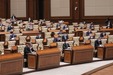
The Senate approved a bill on August 8 that revises liability for a range of extremism-related offenses. The bill was drafted by the Prosecutor General's Office and had previously been passed by the Legislative Chamber. The document consists of 13 articles and introduces amendments to several pieces of legislation.
Presenting the bill, Kutbidin Burkhanov, chairman of the Senate Committee on Defense and Security Affairs, said the first part of Article 244 of the Criminal Code is being amended.
Under the new version, producing materials containing extremist, separatist or fundamentalist ideas, storing them for distribution, or producing and storing the paraphernalia or symbols of extremist and terrorist organizations for distribution or public display will trigger criminal liability only if committed after an administrative penalty has already been imposed for the same conduct. A separate administrative offense is being introduced into the Code of Administrative Liability for this purpose.
Currently, the lawmaker noted, such actions immediately result in criminal prosecution.
"Now, a first offense will draw an administrative penalty rather than immediate criminal liability. This creates a degree of opportunity to bring a person who has made a mistake back onto the right path while safeguarding their rights," Burkhanov said.
"In other words, the scope of extremism-related criminal offenses is being narrowed," he added.
During the discussion, Abdulhakim Eshmuratov, chairman of the Senate Committee on Judicial and Legal Affairs and Anti-Corruption, also noted that a separate article is being added to the Code of Administrative Liability specifically covering the circulation of extremist, separatist and fundamentalist materials.
He said the goal of the amendments is "not to toughen punishment, but to clarify and differentiate liability." This, he said, is expected to help distinguish materials that pose a genuine threat to public safety and order from other, lesser violations of distribution rules.
Possibility of exemption from criminal liability
The bill also allows for exemption from criminal liability for individuals who took part in storing, distributing or displaying materials that threaten public safety and order.
This would apply if the person promptly reported the matter to state authorities or otherwise actively helped prevent serious consequences, and provided their actions did not constitute a separate criminal offense.
Senators described these changes as a liberalization of certain extremism-related offenses.
Different penalties for members and leaders of banned organizations
Article 244-2 of the Criminal Code, which covers liability for creating, leading or participating in the activities of extremist, separatist, fundamentalist and other banned organizations, is also being revised.
Currently, as noted during the session, all three types of conduct carry the same maximum penalty — up to 15 years in prison.
Under the amendments, liability will be differentiated: participation in such an organization's activities will carry a lighter penalty, while creating or leading one will carry a harsher sentence.
Definition of extremism narrowed to eight categories of conduct
One of the most significant changes concerns the definition of extremism itself.
Senators noted that current legislation includes, among other things, a reference to "exceptional forms" of conduct aimed at inciting national, racial, ethnic or religious hostility.
According to Burkhanov, this wording is "very vague" and has drawn objections from a number of international organizations and experts.
"In practice, such wording can create room for overly broad interpretation," he said.
Certain elements of the current definition are subjective in nature and can therefore be interpreted differently in law enforcement practice, the senator noted.
The new bill proposes limiting the definition of extremism to eight specific categories of conduct.
"This represents an important step from the current ambiguity toward clarity," the lawmaker said, adding that it should establish clear legal boundaries for the concept of extremism, prevent overly broad interpretation, and ensure the bill is applied consistently.
The transcript of the session did not itemize the eight categories individually.
"Religious extremism" replaced with "extremism"
The bill also replaces the term "religious extremism," currently used in legislation, with simply "extremism."
According to the lawmaker, this is intended to end the practice of linking extremism to any specific religion and to establish a unified legal approach.
In addition, the bill establishes legal grounds for:
- maintaining an electronic registry of extremist organizations and materials;
- monitoring and assessing related risks;
- state support for scientific research on countering extremism;
- protecting and incentivizing individuals who report extremist activity;
- preventing the spread of extremist ideas online and in the media;
- the social reintegration of individuals convicted of extremism-related crimes.
The bill also provides for the development of a state program to prevent and counter extremism, which is to be approved by the president. The program is expected to include measures to prevent the spread of extremist ideas online, foster tolerance and mutual respect among young people, strengthen interethnic and interfaith harmony, support early detection of new forms of extremism, and improve public legal literacy.
How whistleblowers will be protected
During the discussion, Senator Moira Toshova asked a representative of the Prosecutor General's Office how the safety of citizens who report extremist activity to law enforcement would be ensured, including how they would be protected from persecution or pressure.
The Prosecutor General's Office representative said the bill explicitly guarantees state protection for such individuals. In addition, mechanisms under a 2019 law on the protection of victims, witnesses and other participants in criminal proceedings will apply to them.
Possible protective measures cited included keeping the protected person's identity confidential, providing security for the individual, their home and property, supplying personal protective and technical equipment, temporary relocation to a safe location, resettlement, and changes to the person's place of work, service or study.
Wrapping up the discussion, senators emphasized that the new provisions should be aimed "not so much at punishment as at protection, prevention and public engagement."
The Legislative Chamber had earlier passed the bill in its first reading on April 7. At that time, First Deputy Prosecutor General Bakhriddin Valiyev noted that the current definition of extremism was formulated too broadly and partially overlapped with the definition of terrorism. He said the wording had previously drawn criticism from the United Nations and the OSCE.
The bill included both new mechanisms for countering extremism — including procedures for designating organizations and "informal structures" as extremist, protections for those who report such activity, and social rehabilitation measures — as well as a softening of penalties. In particular, it proposed introducing administrative rather than criminal penalties for certain first-time offenses involving the production and storage of extremist materials.
It also proposed differentiating liability for participating in banned organizations versus creating or leading them. In drafting the bill, lawmakers studied the experience of European countries, CIS states, the United States, Germany, China and others.
Stay up to date with all the latest news: