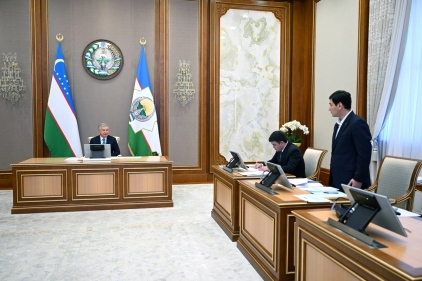
Uzbekistan plans to increase uranium production and expand output of critical minerals and metals, according to plans presented to President Shavkat Mirziyoyev today, Nov. 5 by Navoiyuran and the Uzbek Technological Metals Combine.
Uranium output is to rise from 7,500 tons in 2026 to 15,000 tons in 2030, and proven reserves are to grow to 200,000 tons. In 2026, Navoiyuran plans to expand exploration and drilling, launch additional units for extracting uranium from solutions and create 250 jobs. The share of alternative reagents, which reduce the use of sulfuric acid, is to reach 40% by 2030.
The presentation said global demand for critical minerals is growing by about 10% a year, against 1% for traditional metals. Global uranium demand has risen by 15-20% in recent years and could increase by a further 28% by 2030.
The combine currently produces tungsten, molybdenum, selenium, tellurium and rhenium. Mirziyoyev ordered it to master 11 more products, including nickel, cobalt, graphite, antimony, tin, manganese, platinum, vanadium, mercury and copper. By 2030, production of 16 types of critical raw materials is to be worth more than $2.7 billion.
The combine plans to launch 12 investment projects by the end of 2026. Tungsten processing projects aim to attract $1.1 billion in investment and raise output value to nearly $2.2 billion by 2030.
In June 2026, Mirziyoyev reviewed plans for 120 critical mineral projects worth $4.2 billion in 2026-2030. They include tungsten and molybdenum processing, new production facilities, the Metals of the Future technopark in Chirchik and a research laboratory. A March meeting on mining had set the target of 15,000 tons of uranium by 2030.