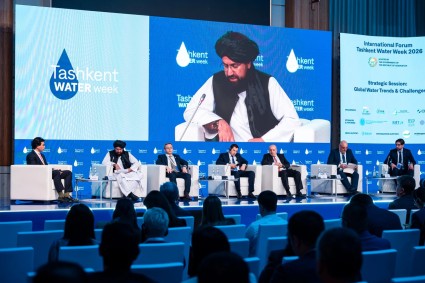
Central Asia and Afghanistan are equally facing the consequences of climate change. Under these conditions, water management ceases to be a purely national issue—it takes on regional and global scales, Mujeeb-ur-Rahman Omar, Afghanistan's Deputy Minister of Water and Energy stated during a panel session at the international forum Tashkent Water Week, held March 25–26.
"Those developed countries that have essentially caused the climate change must help the countries that have become victims of climate change in conducting scientific research, monitoring, and assessing our needs," said Mujeeb-ur-Rahman Omar.
In his remarks, the Deputy Minister paid special attention to the Panj and Amu Darya river basins, which serve as a link between Afghanistan and the Central Asian countries, opening opportunities for strengthening "trust, technical cooperation, and sustainable development in the region."
Mujeeb-ur-Rahman Omar noted that historically, Afghanistan had been taking only very small volumes of water from this river basin.
"Now that security is settled in the country, we believe in the fair and sustainable development of the region. We intend to develop legally, in accordance with the legitimate rights of the countries in the region, and we will take them into account," the Deputy Minister stated.
One of the issues raised by the Afghan delegation was bank protection on the Amu Darya. Mujeeb-ur-Rahman Omar noted that Afghanistan has suffered greatly from soil erosion and the washing away of the Amu Darya basin banks, and appealed to neighboring countries to coordinate national bank protection projects "in the spirit of regional cooperation."
The Deputy Minister emphasized that Afghanistan advocates for the implementation of water-saving technologies, the modernization of irrigation systems, and the exchange of hydrological data, including information on reservoirs. In his view, this will reduce water loss and increase usage efficiency.
"Water is the source of life and the foundation of economic development, a fundamental element of social development. If we combine science, technology, and trust, we can make our region a model of cooperation and practical collaboration for others," the deputy minister said.
Concluding his speech, Mujib ur-Rahman Omar summarized Kabul's official position on transboundary waters.
"The Islamic Emirate of Afghanistan is committed to the equitable and sustainable use of water resources and is ready to play a constructive role. I would like to emphasize that our goal is to receive only what we are entitled to. We do not seek to harm any country. Any misunderstandings that arise can be resolved through negotiations," he concluded.