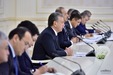
Uzbekistan is planning a sweeping reduction in fines, payments, fees, and bureaucratic procedures for entrepreneurs, the President Shavkat Mirziyoyev said today at the government meeting reviewing the results of the first half of the year and outlining tasks for the remainder of it.
Currently, 51 ministries and agencies have the authority to impose financial fines across 322 categories. Between 2024 and 2026, the total value of fines levied approached 3 trillion soums.
The president stressed that officials with the power to impose sanctions need a fundamental shift in mindset and approach. In his words, before punishing an entrepreneur, they should first be given a chance to correct course and be shown the right path forward.
The meeting also addressed cutting mandatory payments and fees for producers and exporters, given intensifying competition in foreign markets. As one example, officials noted that exporting a single truckload of sweet cherries currently incurs additional costs — customs fees, fumigation, certification, and declarant services — totaling up to 5 million soums.
All ministers and industry heads have been instructed to submit proposals to the Presidential Administration within a week for cutting bureaucracy, fines, payments, and fees, as well as improving the business environment.
At the meeting, Mirziyoyev also took a critical look at first-half results in industry and exports.
Following the first-quarter reviews, administrative penalties were issued to the governors (khokims) of 13 districts that missed industrial targets, as well as 15 districts where exports plummeted. While most local leaders turned things around to meet their mid-year forecasts, growth rates remained sluggish in several areas.
In the Yangiabad district, industrial output grew by a meager 1.8%, falling drastically short of the projected 5.7%. Notable slowdowns were also recorded in Gazgan, as well as the Muzrabat, Kizirik, and Altiarik districts.
Export development efforts were deemed completely unsatisfactory in the Kasbi, Denau, Tashkent, Pakhtaabad, Jambay, Taylak, Bandikhan, Mirzachul, and Yazyavan districts. Similar failures were highlighted in the cities of Jizzakh and Navoi, alongside Tashkent's Bektemir district.
Consequently, the Prime Minister was ordered to immediately review whether 17 underperforming governors should be dismissed from their posts.
The President issued a stern warning that if things do not drastically change by the end of the nine-month mark, severe disciplinary measures will be extended to regional deputy governors as well.
During the same meeting, the Head of State announced the launch of a new, targeted framework across 2,000 of the country's most vulnerable neighborhoods (mahallas) under the "40 Days of Action" program. Governors will be held personally accountable for resolving long-standing issues with electricity, gas, roads, and running water, with the Prosecutor General’s Office and the Chamber of Accounts directly auditing their progress.
Stay up to date with all the latest news: