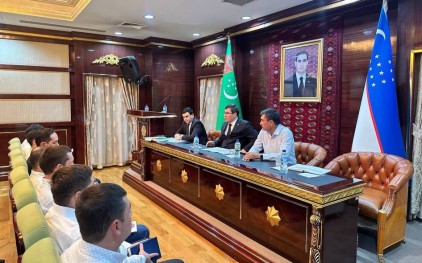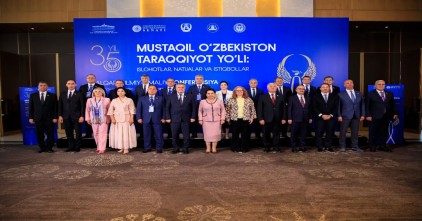
An international conference dedicated to Uzbekistan's 35 years of development, its ongoing reforms, and the evolving role of parliamentary diplomacy was held in Tashkent, bringing together representatives of parliaments from various countries, international organizations, diplomats, experts and government officials.
The conference focused on Uzbekistan's development trajectory since independence, as well as the role parliaments play in addressing international and regional challenges. At the close of the event, participants adopted the Tashkent Declaration, which outlines priority areas for future inter-parliamentary cooperation.
Discussions at the conference, titled "Uzbekistan's 35-Year Path of Development: Reforms, Results and Prospects," centered on constitutional modernization, strengthening parliamentary oversight, improving legislation, public administration, sustainable development and international cooperation.
Nuriddin Ismoilov, speaker of the Legislative Chamber, reviewed the political, social and economic reforms carried out in the country since independence. He noted that the role of parliaments today extends well beyond lawmaking alone.
"Parliaments are emerging not merely as institutions of lawmaking, but as key players in ensuring sustainable development, supporting socioeconomic reforms, and finding effective solutions to global challenges," Ismoilov said.
He added that the discussions at the conference reflected a broader shift in the nature of parliamentary diplomacy itself. Inter-parliamentary relations, he said, are no longer limited to formal visits and meetings but are increasingly expected to build cooperation mechanisms around specific, concrete issues.
Participants also noted that Uzbekistan's ties with the parliaments of neighboring and partner countries have expanded significantly in recent years, with friendship groups becoming more active and the country's engagement on international parliamentary platforms increasing.
Building trust in Central Asia
Foreign parliamentary representatives praised Uzbekistan's approach to regional cooperation and good-neighborly relations. Mahmadsho Gulzoda, chairman of the Committee on International Affairs, Public Associations and Information at the Assembly of Representatives of Tajikistan's Supreme Assembly, spoke about the new political climate that has taken shape in Central Asia in recent years. He said Uzbekistan's open and constructive foreign policy has helped strengthen mutual trust and good-neighborly relations across the region.
"Trust is what creates cooperation. Cooperation, in turn, drives development. And development becomes the solid foundation for peace and prosperity," Gulzoda said.
Merdan Tuvakov, a representative of Turkmenistan's Mejlis, stressed the importance of maintaining direct dialogue between states amid today's complex geopolitical environment. He said inter-parliamentary cooperation should be strengthened in areas such as environmental security, cross-border transport and logistics corridors, and digital transformation, and proposed expanding platforms for dialogue among young parliamentarians and women lawmakers.
Osman Mesten, a member of Turkiye's Grand National Assembly and co-chair of the Uzbekistan-Turkiye inter-parliamentary friendship group, praised Uzbekistan's progress in recent years. He noted that the historical and cultural ties between Uzbekistan and Turkiye are now developing within the framework of a strategic partnership. According to Mesten, current regional and global dynamics are placing new demands on parliaments, making it essential to direct parliamentary diplomacy toward clear goals and measurable outcomes.
"Conducting effective, results-oriented parliamentary diplomacy, developing new approaches, and delivering concrete outcomes is one of the key tasks facing parliaments today," he said.
S.A. Amanova, a deputy in Kyrgyzstan's Jogorku Kenesh, likewise praised Uzbekistan's development over its 35 years of independence, noting that relations between Uzbekistan and Kyrgyzstan have risen to a qualitatively new level in recent years, reaching the level of a strategic alliance. She emphasized the importance of further developing inter-parliamentary ties and expanding cooperation in education, science, innovation and digitalization.
What the Tashkent Declaration entails
The conference concluded with a review of the work carried out by three thematic sections, which examined ways to expand cooperation in cultural and humanitarian affairs, trade and economic relations, transport and communications, and environmental protection. Priorities identified included reducing tariff and non-tariff barriers to international trade, simplifying customs procedures, harmonizing technical standards, developing transport and logistics links, and strengthening digital connectivity.
At the close of the discussions, participants formally endorsed the Tashkent Declaration as a foundation for advancing inter-parliamentary cooperation going forward. The central theme that emerged from the conference was a shared commitment to strengthening trust between states and peoples, sustaining open dialogue, and working together to address common challenges.
Stay up to date with all the latest news: