Over the past decade, Uzbekistan has undergone one of the most significant economic transformations in Central Asia. Since 2016, a series of reforms under the leadership of President Shavkat Mirziyoyev have accelerated the country's integration into the global economy, expanded international cooperation and created new opportunities for entrepreneurs to engage with foreign markets, investors and strategic partners.
As Uzbekistan has become increasingly outward-looking, a new challenge has emerged for many business leaders: succeeding internationally now requires far more than competitive products or access to capital. It demands the ability to build trust across cultures, navigate international negotiations, establish long-term partnerships and understand the increasingly complex dynamics of the global economy.
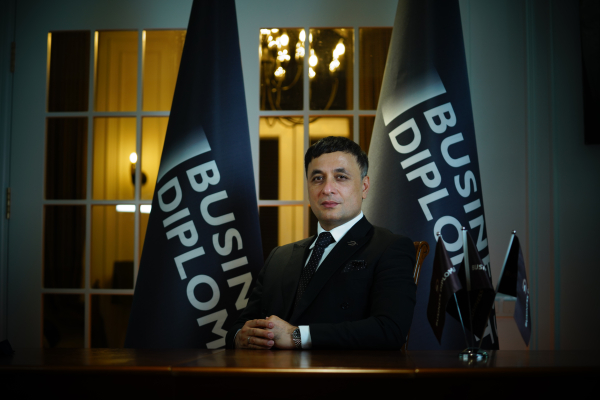
These are the challenges that inspired Uzbek entrepreneur Mirshod Shakirov to establish Business Diplomat in 2023.
Today, Business Diplomat has grown into an international institution dedicated to advancing Business Diplomacy through executive education, international engagement and practical cross-border collaboration. Headquartered in Washington, D.C., with operational activities in the United Kingdom, Central Asia and an expanding network of international partnerships, the institution reflects a broader ambition: preparing entrepreneurs to operate confidently in an increasingly interconnected world.
Business Diplomat describes itself as "The World's First Think-Do Tank on the Modern Silk Road." While traditional think tanks are primarily focused on research and policy recommendations, the institution combines strategic thinking with practical implementation. Rather than stopping at ideas, it seeks to transform them into tangible outcomes through international delegations, executive programmes, strategic dialogue, business missions and institutional partnerships.
For Shakirov, the organisation represents the culmination of years spent working across international business, diplomacy and global institutions.
His professional experience has taken him to projects in the United Kingdom, the United States, China, India, Australia, New Zealand and several other countries. Earlier in his career, he served at the United Nations Headquarters in New York, where he worked within an international environment alongside diplomats, government representatives and global institutions. Those experiences, he says, shaped his understanding of how international relationships influence economic development.
"One lesson became increasingly clear to me," Shakirov says. "In today's world, sustainable success is built not only on excellent products or financial capital, but on trust, long-term relationships and business diplomacy."
Although diplomacy has traditionally been associated with governments, Business Diplomacy has gained increasing attention as a practical discipline that helps entrepreneurs, investors and institutions build productive international relationships. It focuses on strengthening commercial cooperation across borders, encouraging dialogue between business communities and supporting long-term economic partnerships.
Shakirov believes that this approach has particular relevance for Central Asia, where many companies are seeking to expand beyond domestic markets.
"Central Asian entrepreneurs have extraordinary potential," he says. "What many need is not simply more theoretical knowledge, but greater international exposure, stronger professional networks and real experience operating in global business environments."
He argues that modern entrepreneurs increasingly represent more than their companies.
"Today's competition extends beyond individual businesses. Countries, regions and entire economic ecosystems compete for investment, innovation and talent. Entrepreneurs therefore become informal ambassadors for their countries, helping to strengthen international economic relationships through business."
It is this philosophy that underpins the Business Diplomat model.
Rather than focusing on how to establish a business, the institution concentrates on helping entrepreneurs internationalise existing companies and develop the skills required to operate across cultures and jurisdictions.
Its executive programmes combine academic learning with practical experience in areas including international negotiations, business diplomacy, international protocol, strategic networking, engagement with governments and investors, executive communication, personal reputation, geoeconomics and global leadership.
Unlike many traditional executive education programmes, Business Diplomat places significant emphasis on experiential learning.
Participants are encouraged to apply classroom knowledge during international visits, institutional meetings and business negotiations rather than limiting learning to theory alone.
"Knowledge only becomes valuable when it can be applied," says Shakirov. "Every programme is designed to place participants into real international environments where relationships are built through experience rather than simulation."
Since its establishment, Business Diplomat has brought together more than one hundred entrepreneurs, executives and investors through its international programmes.
Delegations have travelled to the United Kingdom, Japan, Germany, Switzerland, the Czech Republic, France, Australia, New Zealand and Malaysia, participating in executive programmes and institutional visits involving universities, chambers of commerce, diplomatic missions, government agencies, business associations and international companies.
According to the organisation, the objective of these programmes extends well beyond educational travel.
Each delegation is designed to create opportunities for international cooperation, commercial partnerships, investment dialogue and long-term professional relationships that continue after participants return home.
The institution's largest Global Exchange programme is scheduled for later this year, bringing delegations to Canada, the United States and the United Kingdom. The programme is expected to include executive engagement with internationally recognised institutions including Harvard University, the University of Oxford, the United Nations and the World Bank.
For Business Diplomat, however, these international programmes represent only one part of a broader vision.
Over recent years, the institution has expanded its collaboration with universities, chambers of commerce, diplomatic missions, government institutions and business organisations across multiple countries. Its long-term objective is to contribute to stronger international economic cooperation while supporting a new generation of globally minded entrepreneurs capable of operating confidently across borders.
Looking ahead, Shakirov envisions Business Diplomat developing into an internationally recognised platform for Business Diplomacy, strategic dialogue and economic cooperation.
Future plans include expanding representative offices, organising international summits and business forums, strengthening institutional partnerships and continuing to build professional networks connecting entrepreneurs, investors, governments and academic institutions along the Modern Silk Road.
"The twentieth century was largely defined by competition for resources," Shakirov says. "The twenty-first century is increasingly becoming a competition for trust. Those who build trusted international relationships will help shape the future of the global economy. Our mission is to help prepare leaders for that future."
In many respects, Business Diplomat reflects the broader transformation taking place in Uzbekistan itself.
As the country continues to deepen its engagement with international markets, entrepreneurs are increasingly seeking not only access to new customers but also stronger global relationships, institutional partnerships and international credibility. Within that evolving landscape, Business Diplomacy is becoming an increasingly relevant component of economic competitiveness.
Business Diplomat is one example of how an idea conceived in Uzbekistan has developed into an international institution with global ambitions. While its future growth will ultimately depend on the impact it delivers, its emergence reflects a wider trend: the growing role of Central Asia in shaping new approaches to international business cooperation.
For Mirshod Shakirov, that remains the institution's central purpose.
"Business has always connected markets," he says. "Our ambition is to help it connect people, institutions and nations as well."