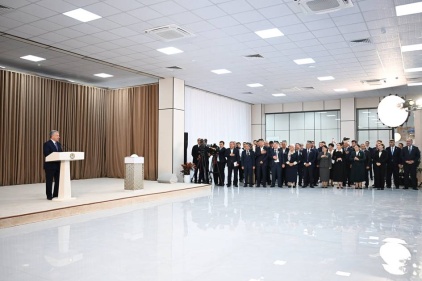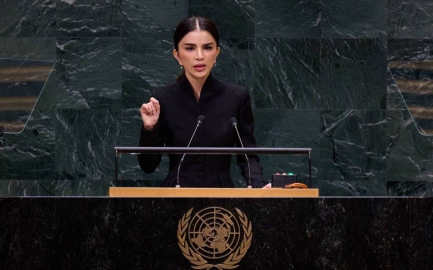
Saida Mirziyoyeva, head of Uzbekistan's Presidential Administration, addressed the annual session of the UN General Assembly on behalf of Uzbekistan. She called for a more effective United Nations and set out reform priorities centered on human dignity.
Speaking in a world of deepening geopolitical rifts, she said humanity is not living through easy times. Wars continue, geopolitical tensions are sharpening, trust is eroding and inequality is growing.
"In this context, Uzbekistan, under its leader, President Shavkat Mirziyoyev, has made its choice. It is a choice of openness, of good relations with our neighbors, of dialogue with the world. Openness is not weakness. It is acting for peace and taking responsibility for the future," she said.
Mirziyoyeva noted that countries are increasingly being asked which side they are on. Uzbekistan's answer is clear, she said: it stands with humanity and with young people who want to shape their own futures. A state's strength is measured not only by its economic or military might but above all by how well it protects human dignity, she said, adding that Uzbekistan sees peace, development and human dignity as a single task.
She said even the most powerful countries cannot solve global problems alone and that threats do not stop at borders, making the UN more important than ever.
"We need a UN that not only makes decisions but is capable of carrying them out. We need a UN in which every country's voice is heard," she said.
Security Council bid
Mirziyoyeva said Uzbekistan supports the UN80 initiative and favors expanding the Security Council. She announced that the country will take over the chairmanship of the Non-Aligned Movement next year and has put forward its candidacy for a non-permanent Security Council seat for 2035-2036, and she expressed hope for members' support. She also stressed that international law is not a tool to be bent to suit interests, and that without common rules there can be no justice.
Regional cooperation and Afghanistan
On regional matters, she said Central Asia was until recently mentioned mainly in the context of disputes. Thanks to the president's initiative and political will, the situation has changed fundamentally, and the region's countries now see one another as partners rather than rivals.
On Afghanistan, she said viewing the country solely as a source of risk, or leaving its people alone with their problems, is not a solution. They must be given reason to trust that a peaceful life is achievable, she said.
Reform record
Mirziyoyeva said the measure at the heart of Uzbekistan's reforms is whether people's lives are improving.
"Over the past 10 years, our people's purchasing power has doubled. The economy has grown from $50 billion to $147 billion. More than $150 billion in foreign investment has been attracted. Exports have nearly tripled. The poverty rate has fallen to 4%, and nearly 10 million people have been lifted out of poverty. Preschool enrollment has risen from 27% to 78%, and higher education enrollment from 9% to 45%. Life expectancy has increased from 66 to more than 75 years. Maternal and infant mortality has fallen fourfold," she said.
Children, environment and technology
She described children as the state's greatest responsibility. She said Uzbekistan is holding talks with the UN Population Fund on demographic stability and will bring the international community together in Samarkand in October to address child welfare and health.
Speaking about the Aral Sea disaster, she called it the result of an unjust attitude toward nature. New Uzbekistan is creating green areas on the dried-up seabed and deploying water-saving technologies, she said, and aims to raise the share of renewable energy to 54% by 2030. She also recalled that, on Uzbekistan's initiative, the UN General Assembly declared 2027-2036 the decade of afforestation and forest restoration.
On artificial intelligence and digital transformation, she said technological progress must keep people and their fate at its center. AI and digitalization must not be separated from human rights, security, equal opportunity and accountability, she said, and technology should serve to improve lives rather than make people dependent. Uzbekistan supports stronger international dialogue on the issue, she said.
Rule of law, women's rights and culture
On the rule of law, Mirziyoyeva said a separate international commercial court based on English-law principles is being set up at the Tashkent International Financial Center. She said child labor and systemic forced labor have been eliminated and that liability for domestic violence has been strengthened. She added that a support system for women's entrepreneurship has been created, and that women now make up 39% of lawmakers.
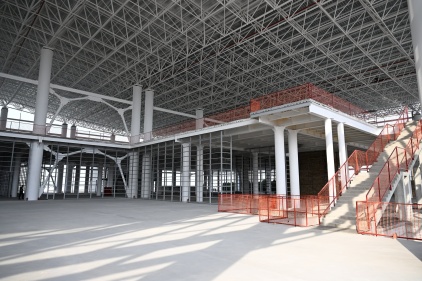
She also said the Islamic Civilization Center, built in Tashkent on the president's initiative, is not merely a showcase of the past but a place of knowledge, thought and enlightenment. Uzbekistan will continue working with international partners to strengthen dialogue among cultures and religions and to promote tolerance, she said.
Closing message
Concluding her speech, Mirziyoyeva said the shared goal is to live in a world where human dignity comes first and to leave children a better future.
"We want to leave our children a better world than the one we have today, a world in which human dignity is held in the highest regard. But the future will judge us not by our capabilities but by how we used them. The people and president of Uzbekistan are ready to help build a world in which peace, solidarity, trust and human dignity prevail," she said.