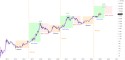
Prediction markets are based on the simple idea that if a person can trade a future event, there is a market price that will reflect the opinions of traders about the probability of the event happening.
This works particularly well in the exciting and rapidly changing world of crypto, where one can see shifts in sentiments, narratives are swapped daily, and traditional market indicators lag behind the current situation. Through those financial actions, the very act of buying or selling contracts based on future outcomes helps effectively transform beliefs into price and, in turn, price into leading signals that get updated in real time. Therefore, prediction markets are discussed as a tool to predict major market cycles like bull runs, drawdowns, and regime changes.
How do prediction markets turn opinions into probability signals?
Most prediction markets provide an event question with clear-cut outcomes, often given as "Yes" or "No," and a specific resolution date and criteria. If a "Yes" contract pays 1 unit to its holder whenever the event happens, and it is trading at 0.65, then the prediction is suggesting approximately 65% probability that the event will happen. Traders whose evaluation of the event differs from the current price on Pjmp2-ethaddr are either buyers or sellers. This process can be seen as one of quickly updating a continuously on-the-fly forecast pushed by news and by traders making their beliefs known to other participants in the market.
This is a very potent mechanism in the realm of crypto because it coaxes stakeholders into acting rather than merely talking, observes StatsGuru. As opposed to people having vague certainty of investment success, a prediction market forces one to decide between two options under risk: if one believes something, one stakes value behind that belief/vision.
One reason predicting the future in cryptos is hard.
Crypto is a reflexive market. When enough people believe a narrative, their actions make it real—until it becomes crowded and unwinds. Liquidity can appear suddenly in risk-on conditions and vanish just as quickly when fear returns. Add leverage, thin books in smaller tokens, and 24/7 global trading, and you get a market where “what should happen” often loses to “what people do.”
That’s why many people search for crypto bull market prediction 2025 even after the year has passed: they want to understand what signals were useful, which narratives were misleading, and how collective expectations formed. Prediction markets can help because they capture expectations as they evolve, not only in hindsight.
What could be predicted in anticipation of the bullish market?
Prediction markets never really predict the future, but they do quantify something of great importance: the strength of belief—considering the veracity of a situation—by which a scenario is unfolding, at what rate that belief changes, and after what new information is disclosed. The activity in the prediction market will reflect the following reasons that support the manufacture of a bull market.
Sentiments shift even before popular narratives begin to catch up.
Levels of confidence change with the mitigation of information on the situation.
Disputes between groups of traders develop.
Known phenomena in financial markets—the risk being repriced when volatility increases.
These signals would be of crucial help in times of indecisiveness in the market; in crypto, perhaps the most difficult times are simply not the clear highs and lows, but those moments where—with some arguing the next rally is due—the participants are looking to trap others.
How to word questions in a "bull market" in the prediction market?
The most important factor when it comes to using a prediction market is the question that is being focused upon. The same can be said for the topic being highlighted, "Will crypto enter a bull market?" It's quite a weak question. A good question should have some definite measurable criteria and a fixed timeline. If, for instance, the question is, "Will the market valuation of a particular asset surpass a prior milestone within a specific deadline?" "Will the aggregate market capitalization overcome a certain milestone, and are certain macro conditions lined up, causing mass trends?" are other examples.
The clarity and precise question really matter because poorly worded and uncertain resolution rules wreck market trust and result in distorted pricing levels. If market participants are unclear about what is valid within the resolution, they either stay clear of it or choose to consider pure sentiment during decision-making, which would obviously act against the prediction signal.
The most significant limits of using prediction markets for crypto calls
Prediction markets have flaws, and these are augmented by crypto. Usually, low liquidity means noisy prices, and the behavior of large actors can move implied outcomes in smaller markets. Besides, herd behavior can manifest: if a story takes off, the market can be invaded, and prices may well reflect hype rather than balanced probability.
Supplying assurance and facilitating the formation of such markets only in delayed response to very technical developments in question further aggravates the limitations. This is because most participants in the market, while ordinary people, lack skills to correctly price such events. Lastly, probabilities, providing an individual with their actuarial value, may appear wrong simply because probabilities do not guarantee the occurrence of the very thing to which they are attached. A 70% chance is still committed to letting one down 30% of the time.
Do Not Touch Prediction Market Signals without an Abundance of Caution
The best use of prediction markets is as an input to a decision system, rather than a direct oracle. A prediction price says a lot about the crowd's confidence, but at the same time, you need good risk management and scenario planning. Here is a suggestion:
- Monitor the status quo to evaluate how probabilities shift after major news.
- Check how stable or volatile prices are.
- Time how different related markets confirm or contradict one another.
- Usually, theories on why sentiment will change smoothly or simply explode
When implied probability moves away drastically due to the slightest news, this volatility might point toward thinner liquidity or weaker conviction. It would mean much broader agreement if the probability were to continuously move up as events mature. Either way, the interpretations become rather robust when one looks at the situation in the context of liquidity, volatility, and timeframe.
Why communication and trust account for more prediction market results than people generally expect
Prediction markets are financial products but also trust products. People participate when they understand the rules, feel as though the resolution process is fair, and trust the credibility of the platform. If the interface is confusing or the wording is sloppy, then participation quality drops, and so does the informativeness of a market.
Here is where a strong digital strategy can give you a competitive edge. Clear messaging, coherent branding, and user orientation will increase the quality of the crowd signal by attracting more informed participation and reducing misunderstanding.
Brief discussion about ProZephr's relevance with prediction market platforms.
Zephyrus falls in the realm of prediction market products because of the necessity for these platforms to elucidate convoluted mechanisms to the markets with simple yet believable language. A potent digital strategy aids the platform in positioning itself and educating its users, building credibility incrementally over time. Whenever a market audience is inhabited by a skeptical crowd that is used to having slightly battered attention, absolute clarity of tactics shall make for the very best catalyst of adoption. Specifically in the context of prediction markets, clarity is not just a marketing tool; it is also a key part of the market's integrity because it ensures that participants understand both the nature of their trade as well as the procedures for resolving the outcomes. What can prediction markets not replace?
Prediction markets never replace less central methods like greater due diligence on fundamentals, liquidity analysis, or investment stewardship. They also never replace investing one's views on something likely to occur if there were a radical regime change. The cryptocurrency cycles are subject to macro conditions, leverage, and technology shifts that may push the cycles in different directions, and none of these elements ever translates cleanly into a single probability number.
Indeed, prediction markets are capable of navigating through the fogginess themselves. They act as a live snapshot of belief and conviction, instantly alerting investors to developments in the crowd. It can happen quicker than the news channels realize.
Conclusion
Prediction markets provide a fantastic tool to gauge collective expectations during cycles and shifts in narrative within the crypto community. They translate uncertainty into probability-like signals. They must be designed with clear questions and a formal procedure of settling the market to yield meaningful predictions. When viewed and talked about transparently, they supplement research and risk planning, promoting a deeper understanding of market confidence or whatever else might be in the air at a particular point in time. Trust and communication can influence adoption. Thus, digital strategy and communication—things where teams like Zephyr really come into play—have a genuine capacity to shape prediction market platforms as credible forecasting tools or vacant houses of sentimental release.