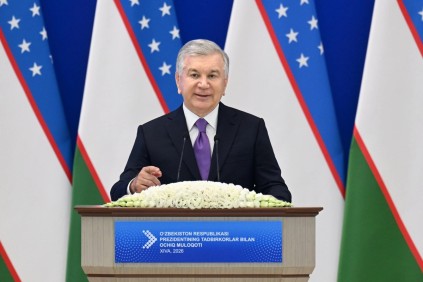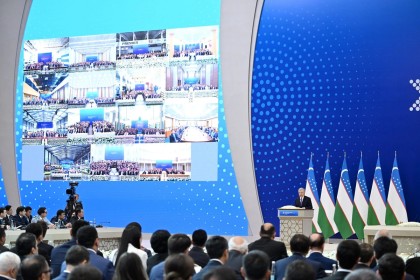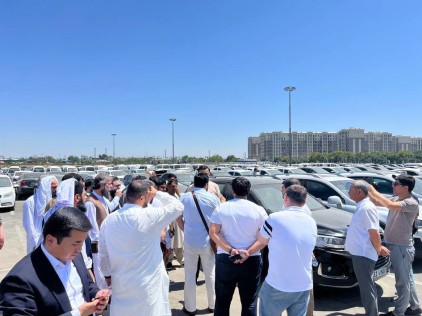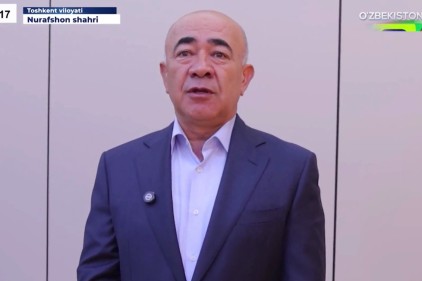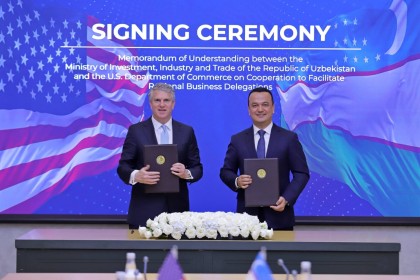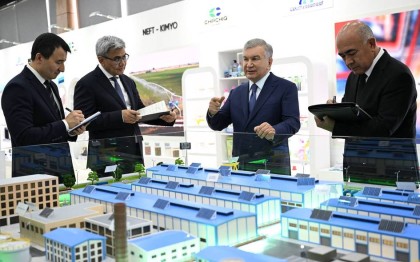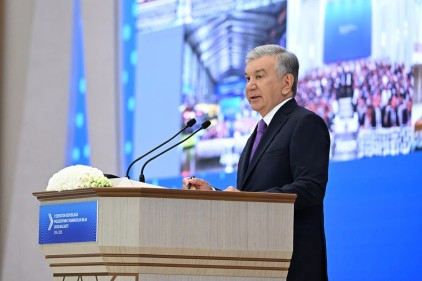
During the meeting with business leaders today in Khiva, the President Shavkat Mirziyoyev announced the remaining of the business stimulus package. This year, for the first time, about 25,000 business representatives took part remotely through district-level video studios, presidential press secretary Sherzod Asadov said.
Mirziyoyev congratulated the country's business community, which numbers 1.2 million businesses, on Doing Business Day.
He said that in the five years since the annual open dialogues with business leaders began, thousands of issues hindering doing business have been resolved, with 84 laws and 861 decrees and resolutions adopted ever since.
"Why? To ease doing business, to increase the number of new jobs, to give people the chance to earn an income close to home — right in their own mahalla," the president said.
Over this period, the credit portfolio allocated to business support has nearly tripled, reaching 450 trillion soums, and businesses have benefited from tax and customs incentives worth 650 trillion soums. Business representatives have also independently attracted $1 billion in financing from foreign banks for their projects — a milestone Mirziyoyev called another major achievement by Uzbekistan's businesses.
From starting a business to building capital
The president said doing business in the country is entering a new stage of development.
"Today our businesses are moving from the stage of 'starting a business' to the stage of 'building capital,'" Mirziyoyev said.
Over the past five years, fixed-capital investment by businesses has tripled to 363 trillion soums. The number of districts where industrial output exceeds $100 million has grown from 66 to 116, while growth in information technology, fintech and other service industries has pushed the number of districts generating more than 1 trillion soums in services from 41 to 152. About 3,500 enterprises now work with leading international online marketplaces.
Figures presented at the meeting showed that more than 550 businesses who started out in their local mahallas now operate dozens of branches nationwide, while more than 300 business owners have built their own national brands.
Mirziyoyev also pointed to an increased domestic supply of copper, gold, rolled metal, polyethylene, PVC, kaolin and other raw materials, which he said has driven a "major leap forward" in electrical engineering, construction materials, pharmaceuticals, textiles and furniture manufacturing. New industries have also emerged in recent years, including electric vehicles, polymers and household chemicals, green energy, and jewelry production. Modern car plants operated by BYD, ADM Jizzakh and Sirdaryo Asaka Motors, officials noted at the meeting, have brought new expertise and technology to the sector.
Energy down-payment requirement eased for compliant businesses
Uzbekistan will cut the required prepayment for electricity and gas from 100 percent to 15 percent for some businesses, Mirziyoyev announced. The measure will apply to companies connected to automated electricity (ASKUE) and gas (ASKUG) metering systems that have maintained a clean payment record.
The president said many businesses had complained that the 100 percent prepayment requirement for energy resources was straining their working capital.
"Overall, we are fundamentally overhauling the management system in the energy sector. A new system will operate in every district, one that takes into account businesses' current needs and their future plans," Mirziyoyev said.
The 100 percent prepayment rule for electricity and natural gas for legal entities has been in effect since July 1, 2024. A similar rule was previously in place from July 2017 to February 2019, after which the mandatory prepayment level was cut to 50 percent. In late 2023, the Energy Ministry attributed the return to a 100 percent advance payment to violations by consumers, saying a shortage of metering equipment had led to unauthorized grid connections and manipulated consumption data.
New terms for construction companies
The president also said that starting in 2027, a new approach will be introduced in the construction sector to encourage the growth of contracting and design firms.
Regardless of a construction site's location, budgets will allocate funding equal to 5 percent of the minimum wage for every labor-hour worked. Cost estimates for state construction projects will build in a 7 percent profit margin for contractors, while design work will be funded at 4 to 7 percent of a project's total cost, depending on its complexity.
50 companies a year to be groomed for IPOs
Uzbekistan will select 50 private companies with annual revenue above 1 trillion soums each year to help prepare them for entering the capital markets, Mirziyoyev announced.
An accelerator program will be launched jointly with leading investment banks, under which the state will cover 50 percent of companies' costs to prepare for an initial public offering and bring their financial reporting in line with international standards. The president estimated the measure would allow the private sector to attract at least $1 billion a year from abroad.
Mirziyoyev noted that this year, for the first time, a 30 percent stake in the National Investment Fund, which holds assets in 13 strategic companies, was listed on the Tashkent and London stock exchanges — an experience he said has opened the door to international capital markets for private businesses as well.
AI Partner for 10,000 businesses
Mirziyoyev named the creation of an "artificial intelligence — management efficiency — new investment" ecosystem as the third pillar of the new initiatives.
"Tomorrow's market will belong to the entrepreneur who increases added value, boosts productivity through artificial intelligence, and works to lower production costs," he said.
Analysis presented at the meeting found that 54 percent of businesses who adopted modern management methods and AI-based tools saw a significant increase in demand for their products. A quarter of companies reduced their production costs, and revenue growth at 40 percent of companies allowed them to raise employee salaries by more than 10 percent.
The first supercomputer cluster has already been launched at the Digital Government Project Management Center, with its capacity set to triple in 2027. A new program, "AI Partner for 10,000 Businesses," will cover 50 percent of companies' costs for adopting artificial intelligence. Businesses developing AI models for new products will be able to use the supercomputer free of charge, with research and development costs also covered by the state budget. Ready-made AI solutions will be made available through an open platform for businesses, with at least $100 million allocated for the program's first phase.
Automation cost compensation extended to more industries
The president said a support scheme already used in the textile industry will be extended to electrical engineering, construction materials and food production, with companies in these sectors reimbursed for 50 percent of the cost of implementing automated management systems.
Relief on export revenue rules
A separate set of measures addresses overdue export debts and foreign currency earnings. Foreign currency deposited into a bank account by year's end to settle outstanding debts will now count as export revenue, and restrictions on further exports will be lifted in cases where payment for previously shipped goods has yet to arrive.
The requirement for a 50 percent invoice prepayment will be scrapped, and for exports carried out through trading houses and distributors, the deadline for receiving foreign currency earnings will be extended from 180 to 365 days.
Export navigator
A system called the "Export Navigator" will be launched to guide businesses through every stage of entering foreign markets. A list of 100 products in high demand abroad will be drawn up, with the competitive landscape, tariff conditions and logistics solutions worked out for each one, and the production processes of 2,000 enterprises will be adapted to meet the requirements of foreign markets and specific buyer segments.
Businesses will be reimbursed for half the cost of hiring foreign branding specialists, up to $500,000, while subsidies of up to $50,000 will support promoting national brands abroad. The state will also cover 50 percent of the cost of warehousing goods and selling through online marketplaces, and 80 percent of consulting costs for participating in international tenders. At least $1 billion will go toward a unified system of support for exporters.
"The global competition for markets is intensifying by the day. In these conditions, an entrepreneur entering a foreign market should never feel alone," Mirziyoyev said.
Export Ambassadors in 25 countries
The president also instructed diplomatic missions to play a bigger role in promoting Uzbek business abroad, helping businesses enter new markets and identify export opportunities.
"Export ambassadors" will be appointed in 20 countries that account for 60 percent of Uzbekistan's exports, as well as in five other promising markets, chosen from among the businesses who export the most to each respective country. They will help other companies gain access to retail chains and navigate certification and marketing, with their travel and accommodation costs covered by the state.
Shrinking the shadow economy through explanation, not checks
Uzbekistan's tax burden has fallen from 13.4 percent to 12 percent over the past three years, while the share of the shadow economy has shrunk from 50 percent to 26 percent over the past decade, Mirziyoyev said.
"Bringing the economy out of the shadows should happen not through inspections, but by explaining the correct way of doing business to businesses and helping them follow it," he said.
The president said an analysis of 5,000 businesses found that more than half had faced tax inspections two to three times a year, and another 21 percent had faced four. On top of tax inspections, businesses also contend with repeated checks by fire safety, construction, sanitary, quarantine and energy inspectors.
"We need to understand one thing: where there is no peace of mind, there will be no freedom, no development, and no drive toward anything new," the president said.
Stanstill on small-business checks
Mirziyoyev announced a three-year moratorium on inspections of small businesses, covering checks not related to risks to public health or the interests of other businesses; inspections will continue in cases where such risks exist.
For medium-sized and large businesses, a voluntary preventive audit mechanism will be introduced: if a business owner conducts such an audit independently, tax authorities will recognize its findings, and businesses who correct any violations found will not be fined. A repeat inspection of a business within one year will require approval from the business ombudsman.
Uzbekistan has already had a moratorium on additional obligations for small businesses in place from July 1, 2025, to January 1, 2028, and is introducing a "first chance" principle under which businesses will not be penalized for a first violation in their first year of operation.
'Silence means consent' for half of business-related government services
Uzbekistan will shift 50 percent of government services related to doing business to a "silence means consent" principle, Mirziyoyev announced. Under the new rules, if an entrepreneur's application is not processed within the set deadline, it will automatically be considered approved.
The president also said the business ombudsman will review every case of a license denial, with penalties for unjustified refusals set to be toughened.
Dozens of licenses and permits to be scrapped
Licenses and permits will soon be eliminated for more than 30 types of business activity. Processing times will be cut two- to three-fold for another 35 categories, and 10 types of permits will shift to a notification-based system. Before any new license or permit is introduced, it will first be piloted for six months in three regions.
Single certificate for food exports
Permitting procedures will also be simplified for food exporters: instead of separate veterinary, sanitary and phytosanitary permits, a single "Health Certificate" will be issued.
Mirziyoyev separately noted the large number of complaints from businesses over asset freezes imposed under enforcement orders, saying a dedicated meeting would be held on the issue to develop systemic solutions.
Fines in Uzbekistan will be cut roughly in half on average, and businesses will be given 10 days to correct a first-time, low-risk violation, the president said. Starting in 2027, a "presumption in favor of the entrepreneur" will apply in disputes with the state.
All fines on businesses to be cut by half on average
According to the president, 51 government agencies currently have the authority to impose financial penalties. He criticized the practice of letting regulatory bodies keep a share of fine revenue for their own use.
A fine should not be a way to collect money, but a tool to maintain order, discipline and prevent violations within an industry, Mirziyoyev said.
In addition, the return of deposits to businesses for goods purchased by state enterprises will be automated.
Presumption in favor of business entity
Starting in 2027, a presumption in favor of the entrepreneur principle will be introduced in disputes between businesses and the state. Under the initiative, an entrepreneur will be presumed not at fault until guilt is proven in court, and no fine or other punitive measure can be applied before that point.
At the same time, a warning for a first violation rule will take effect: if an entrepreneur commits a first-time violation that causes no harm to people's life, health or property, they will be given 10 days to correct it.
Regulators will have to pay court fees
Mirziyoyev also announced changes to how legal disputes with government bodies are handled. After a case is heard in the first instance, regulatory agencies will be required to pay a state fee at every subsequent stage of litigation. In addition, the Expert Council under the Chamber of Commerce and Industry will be given authority to review disputes in the customs, construction, sanitary, quarantine and veterinary spheres.
105 new industrial and infrastructure projects planned
Uzbekistan plans to launch 105 new industrial and infrastructure projects worth a combined $27 billion in 2026, Mirziyoyev said.
Among the major projects expected to give an additional boost to economic growth, he said, are a nuclear power plant under construction in the Jizzakh province, due to come online by the end of 2029; a fourth copper concentration plant in Almalyk; and modern highways linking Tashkent with Samarkand and Tashkent with Andijan. A facility to produce sustainable aviation fuel is under construction in the Khorezm province, a 940-hectare greenhouse complex is being built in the Surkhandarya province, and the New Tashkent airport is under construction in the Yukorichirchik district of the Tashkent province.
New residential districts designed to house a combined 3 million people are also being built across every province of the country. The president said local businesses wishing to supply goods and services for these projects will be given equal terms with foreign investors.
Logistics and new financial hubs
Mirziyoyev also outlined measures to develop transport and logistics infrastructure. Customs duties and recycling fees on imported trucks have been eliminated, and the value-added tax rate on railcars used for international transport will be set at zero.
In 2027, Uzbekistan plans to launch a logistics center with a capacity of 500,000 tons at Georgia's port of Poti, with construction also beginning on a related project at the port of Anaklia, also in Georgia. Transport Minister Ilkhom Makhkamov said in July that more than 60 percent of Uzbek freight carriers now use routes through Georgia. Major transport and logistics hubs are also planned for Alat, Termez, Yangiyul, Akhangaran and Khanabad.
Next year will also see the launch of the Tashkent International Financial Center and the Enterprise Uzbekistan international digital technology center. The president said these projects are expected to attract $20 billion to $25 billion in capital, along with new expertise and technology.
Incentives and new markets for businesses
Mirziyoyev also highlighted business-support measures adopted earlier this year. The threshold at which businesses become subject to value-added tax was raised from 1 billion to 5 billion soums, and cafes and restaurants received 100 billion soums in VAT cashback. The introduction of a zero VAT rate on agricultural products left farmers with roughly 400 billion soums in additional funds, he said.
Through the National Industrial Chain system, private companies received 4 trillion soums worth of orders from major state enterprises. State strategic enterprises have also published a list of more than 650 new product categories proposed for domestic production, which the president estimated has created a $1 billion market opportunity for businesses.
On trade, Kazakhstan has lifted import restrictions on 11 types of construction materials, and a mutual duty-free trade regime has been introduced with Turkmenistan. Preferential trade agreements covering hundreds of product categories have also been signed with Jordan, Pakistan, Iran and Afghanistan.
The president noted that despite challenging global economic conditions, Uzbekistan's GDP grew 8.5 percent in the first half of the year, and Fitch and Moody's each raised the country's sovereign credit rating by one notch — results he said were above all the product of reforms carried out in partnership with businesses.
Hotel tax breaks extended to 2030
A tax break allowing hotels to pay land and property taxes at rates 10 times lower than standard will be extended through 2030. Banks will install ATMs capable of accepting foreign cash currency in hotels with more than 50 beds.
Mirziyoyev also said tour-operator services provided to foreign tourists will be classified as exports and exempted from value-added tax. Customs incentives for importing tourist buses, electric buses and minibuses will be extended for another year, and no recycling fee will be charged on the import of these vehicles either.
Stay up to date with all the latest news: