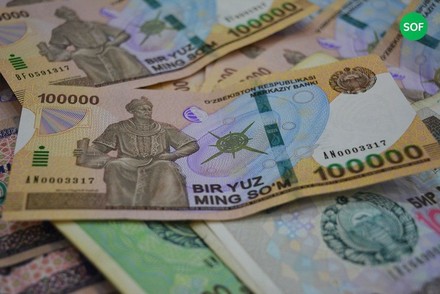
Uzbekistan is considering a phased increase of its national minimum wage to reach 40% of the median salary by 2030, according to a new policy proposal. The comprehensive reform package also suggests decoupling the minimum wage from the salary calculation formulas used in the public sector, while exploring the introduction of provinceal and industry-specific minimum pay scales.
These structural recommendations were detailed in an analytical report on optimizing the country's minimum wage architecture, published by the Institute for the Reduction of the Shadow Economy and Fiscal Analysis under the Ministry of Economy and Finance.
Currently, Uzbekistan’s minimum wage stands at 1.271 million soums (approximately $104). International databases, including WageIndicator, reveal that this threshold lags behind several CIS neighbors. By comparison, the minimum wage is roughly $180 in Kazakhstan, $295 in the Russian Federation, and around $265 in Belarus.
With the country's median monthly salary hovering near 5.3 million soums, the current ratio of minimum-to-median wage—known as the Kaitz index—sits at roughly 24%. The institute's report underscores that global standards typically gauge minimum wage adequacy within a benchmark range of 40% to 60% of the median salary. Evaluated against this international metric, Uzbekistan's baseline pay structure is classified as comparatively low.
The authors of the document propose increasing this metric to 40% of the median salary by 2030. Based on current median wage figures, this adjustment would elevate the minimum wage to nearly 2.1 million soums—approximately 1.7 times its current level. However, the report emphasizes that this increase must be implemented gradually, taking into strict account household income dynamics, prevailing labor market conditions, and overall economic capacity.
Why the Current Model is Deemed Problematic
The policy brief points out several systemic limitations inherent in Uzbekistan's existing minimum wage framework. Chief among them is that the minimum wage simultaneously serves two conflicting purposes: it acts as a baseline social safety guarantee for workers while concurrently functioning as the calculation matrix for public sector salaries.
Because it is directly tethered to the unified tariff scale, any hike in the minimum wage automatically inflates the entire public sector payroll fund. This structural link creates a direct correlation between social welfare policy and state budget expenditures. Consequently, the minimum wage threshold is frequently dictated by fiscal and budgetary constraints rather than the actual needs of workers or the rising cost of living.
According to the document, public sector labor expenditures currently account for 42% to 45% of total government spending. As a result, implementing any substantial minimum wage increase without first dismantling this interconnected model would exert severe and immediate fiscal pressure on the national budget.
A cornerstone of the proposed reform is the institutional separation of the minimum wage's functions. The authors of the report advocate for completely abandoning the use of the minimum wage as a benchmark for calculating public sector payroll funds.
In its place, they propose introducing an independent baseline tariff value. According to the authors, this approach would eliminate the direct dependency between worker social safety nets and government budgetary burdens.
In other words, the minimum wage would function strictly as a baseline social guarantee for employees, while public sector salaries would be calculated using an entirely separate tariff base. This structural shift would empower the state to increase the minimum wage to protect workers without triggering an automatic, proportional spike across all related government expenditures.
Minimum Wage Could Vary by Province and Industry
Another key recommendation involves exploring the territorial differentiation of the minimum wage. The policy brief highlights that Uzbekistan’s labor market is highly fragmented, with household incomes and the cost of living varying dramatically from one province to another.
According to official statistics, average salaries in Tashkent are 1.5 to 2 times higher than in certain provinces. Under these conditions, a uniform national minimum wage produces highly uneven outcomes. In the capital, the current baseline fails to reflect actual living expenses, whereas in economically quieter provinces, a substantial flat hike could impose an excessive burden on local employers.
To address this, the authors propose introducing provinceal coefficients or alternative mechanisms to tailormake the minimum wage to local realities. This localized approach would boost the adequacy of baseline pay in highly developed economic hubs like Tashkent while keeping regulations manageable for businesses in lower-income provinces.
Furthermore, the report suggests an experimental initiative to raise the minimum wage by up to 30% within specific targeted sectors, namely construction, retail trade, and food services. These industries have been singled out due to their unique employment structures, demanding working conditions, irregular hours, and distinct income patterns.
Hourly and Daily Minimum Compensation
The policy document also proposes developing industry-specific baseline salaries alongside introducing mandatory hourly and daily minimum wage rates.
Currently, the minimum wage is predominantly perceived as a monthly metric. However, this framework is poorly suited for employees engaged in part-time, temporary, or seasonal labor. This is especially true in sectors driven by flexible schedules, shift work, day labor, or fractional employment. Implementing hourly and daily minimum pay standards would extend vital wage protections to a much broader demographic of the workforce. The report explicitly highlights support staff and junior medical personnel as primary examples of categories that would benefit from this shift.
The text notes that executing these reforms will necessitate strengthening social partnership institutions—meaning a far more active collaboration between the state, employers, and trade unions to collectively determine compensation conditions.
The Challenge: Enforcing the Minimum Wage Beyond the Numbers
A distinct section of the proposal focuses on compliance and enforcement. The policy brief emphasizes that a nominal hike in the minimum wage will accomplish little if a vast segment of the workforce remains marooned in the informal market or continues to receive under-the-table cash payments.
Data shows that roughly 15% of employees earn less than 1 million soums, while another 21% pull in an income hovering right at the bare minimum wage line.
According to the data cited in the document, informal employment in Uzbekistan remains stubbornly high at 38% to 40%. Out of an economically active population of 14.7 million people, only about 5.4 million are registered in the formal sector. Furthermore, businesses frequently engage in the practice of officially registering an employee at the minimum wage threshold while paying the remainder of their salary under the table.
To improve compliance, the institute recommends deploying digital employment tracking systems, simplifying the bureaucratic process of hiring, and optimizing specific labor laws regarding hiring and termination. The primary focus is on reducing administrative and transactional costs for business owners. The core philosophy here is simple: the more complex and expensive it is to hire someone legally, the greater the incentive for employers to retreat into the shadow economy.
The International Context
The policy brief notes that global best practices and recommendations from the International Labour Organization (ILO) were thoroughly analyzed during the development of these proposals. Specifically, ILO Convention No. 131 stipulates that establishing a minimum wage must balance the basic needs of workers and their families with broader macroeconomic factors—such as labor productivity, general employment rates, and overall economic capacity.
Different regulatory frameworks are utilized across the globe to govern minimum compensation. In Germany, for example, the national minimum wage acts as a universal social baseline, while individual sector salaries are negotiated through collective bargaining agreements. Kazakhstan employs a separate base official salary specifically for its public sector employees. Meanwhile, Japan sets its minimum wage at the prefectural level to directly account for provinceal variations in the cost of living.
Furthermore, several European Union member states widely implement mandatory hourly minimum rates and routinely adjust baseline pay to keep pace with inflation, changing tariff scales, and evolving labor market conditions.
The authors of the brief stress that these international frameworks cannot simply be dropped mechanically into Uzbekistan, as they matured under entirely different institutional environments. Their successful implementation locally hinges on the strength of domestic collective bargaining, the formalization of the labor market, and the overall efficiency of regulatory enforcement systems.
What Lies Ahead
If these proposed reforms are successfully put into action, the minimum wage in Uzbekistan will phase out its role as a rigid, symbolic bookkeeping benchmark. Instead, it will transform into a robust and effective instrument of baseline social protection for the country's workforce.
Lifting the minimum wage to 40% of the median salary will bring Uzbekistan closer to international benchmarks, yet it demands a cautious approach to avoid saddling businesses and the state budget with excessive financial burdens. Decoupling the minimum wage from the public sector tariff scale would hand the government far greater fiscal flexibility when upgrading vital social safety guarantees.
Furthermore, introducing provinceal and industry-specific variations, alongside structured hourly and daily minimum rates, could make the overall compensation framework much more adaptive to the true dynamics of the labor market. However, the ultimate efficacy of these sweeping reforms will hinge entirely on how successfully the state can shrink informal employment and enforce actual compliance with the new baseline standards.
Meanwhile, a Central Bank review highlights that while real wages in Uzbekistan are growing at a slower pace than in neighboring Central Asian and Caucasus nations, the country's ratio of minimum wage to GDP per capita remains higher. This specific metric indicates a comparatively more equitable distribution of baseline income across the population.
Stay up to date with all the latest news: