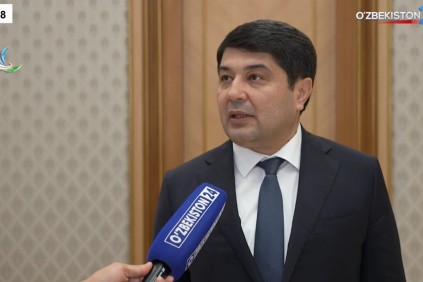
In his remarks last week, the Chairman of the State Security Service, Bakhodir Kurbanov named corruption as one of the four main threats to Uzbekistan. So, what is expected to be done to address it? The presidential Decree stipulates changes in the fight against corruption.
Large projects to be scrutinized
The Decree has given new powers to the Anti-Corruption Agency.
In particular, the Agency will now be responsible for identifying and preventing corruption factors, including conflicts of interest in decision-making on projects financed by international financial institutions and foreign governments.
Considering that projects financed by external sources are often quite large, worth millions or billions of dollars, this is one of the most important of the Agency's new powers.
Secret documents
According to the given directive, the Agency must put an end to the unlawful concealment of decisions and orders issued by ministers, governors and other officials from the general public. This is about the E-Decree system. By the Decree, the Agency headed by Akmal Burkhanov has been authorized to monitor compliance with the legislation on openness in the E-decree system and apply effective steps to ensure openness.
Unjustified failure to publish documents adopted by the national and local executive authorities in the E-decree electronic system shall be deemed a violation of the legislation on openness of activities of state authorities and management bodies and is grounds for appropriate liability, the Decree says.
Anti-corruption appraisal
The Anti-Corruption Agency has also received the authority to coordinate the process of conducting anti-corruption appraisal of existing regulatory documents. Previously, the Agency had been conducting anti-corruption appraisal mainly of newly developed documents. Now, thousands of documents that have already been adopted and are currently in force can also be subject to examination. If corruption risks are identified in them, the Agency shall file information about this to the Presidential Administration.
In addition to the above, the Anti-Corruption Agency was also designated as the authorized body for developing minimum requirements for digitizing the most corruption-prone processes in state bodies and organizations, and for introducing a national anti-corruption management system in state bodies and organizations.
Requested information must be provided
According to the Decree, from now on, failure to provide the information requested by the Anti-Corruption Agency or providing incorrect information shall be deemed as obstruction of the Agency's legitimate activities.
Also, if the Agency detects a corruption risk in a system, it has the right to file submissions to the highest responsible body in that system, which must be deemed.
Protection order
The Agency will take persons who blow the whistle on corruption cases under its protection. That is, if someone reports corruption, the Agency will introduce the practice of issuing a protection order to protect them from persecution and harassment.
The actual meaning of a protection order, the period for which it will be issued, and other issues will be clarified in the relevant regulatory document. The draft document is expected to be ready in May 2026.
Internal control units
The anti-corruption policy places special emphasis on internal control units in state bodies and organizations. According to the Decree, the activities of these units will be organized in close cooperation with the Agency.
Key performance indicators (KPI) will not be applied to the activities of heads and employees of internal anti-corruption units. They will be paid bonuses tied to KPI in the maximum amount. The Agency's consent will be required to hold them accountable.
If the Agency considers that the risk of corruption in an organization is high, it may expand the internal anti-corruption control unit in that organization and add additional employees. The appointment and dismissal of additional employees is carried out by order of the Director of the Agency.