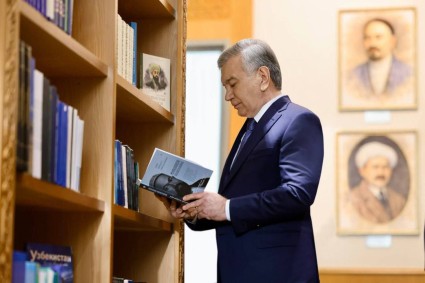
President Shavkat Mirziyoyev inaugurated the Center for Islamic Civilization in Tashkent on Tuesday, the presidential press service said in a statement.
Reportedly, the Center has become one of the largest complexes in the world for study and popularization of history, culture, and Islamic civilization, and its scale can bid for inclusion in the Guinness Book of World Records.
The Center is built on the grounds of the Hazrati Imam Complex, covering an area of 10 hectares. The three-story building is 161 meters long and 118 meters wide. Its dome reaches 65 meters in height, and the total usable area exceeds 42,000 square meters.
According to the presidential press service, the building was designed based on the architectural ideas and proposals of Shavkat Mirziyoyev,. It can be entered from four sides, through four main portals. These portals and the building's outer arches are decorated with verses from the Quran and hadiths expressing ideas of enlightenment, generosity, humanism, and respect for parents.
The basement floor houses a special platform for children, a restoration and digital copying laboratory, storage facilities for museum exhibits and rare manuscripts, a modern cafeteria, and museum vestibules.
The ground floor houses the museum with an exhibition hall covering approximately 8,350 square meters and a 550-seat conference hall. The first floor houses the Muslim Directorate, a library with a collection of manuscripts and lithographic sources, printed and electronic literature, reading rooms, and facilities for international organizations and academic institutions.
The Quran Hall, with its unique exhibits, is deemed the spiritual heart of the Center. A special holographic mapping system has been created under the dome, first showing an image of space, followed by the twinkling stars in the sky. The star composition is based on a map of the stars visible in the Tashkent sky at night. Ninety Swarovski crystals and over 650 lamps are used as stars.
Along with the Mushaf of Uthman (the Uthman Quran, the oldest handwritten version of the Quran, is included in the UNESCO Memory of the World Register), the Center houses 114 rare Quran manuscripts belonging to the country, created during the reigns of various dynasties. These include rare examples dating back to the Samanid, Karakhanid, Ghaznavid, Timurid, Shaybanid, and other eras.
The Center's collection contains over 2,000 ancient sources, and over 60 rare Quran manuscripts. All of these were preserved and donated by compatriots, as well as acquired through international auctions.
Particularly valuable manuscripts include the "Bozuband" manuscript of the Quran, executed by the calligrapher Sultan Muhammad in 1589 in an octagonal form and also used as a tumar; an exquisite 17th-century copy reflecting the flourishing era of calligraphy and book art during the Safavid period; and a rare manuscript created by the calligrapher Muhammad ibn Abd al-Hadi in 1872 in the Maghrebi script.
Also on display is a unique copy from the 12th-13th centuries of the Seljuk period, executed by the calligrapher Muhammad Sodiq ibn Muhammad Shafi'i in the naskh script with Farsi translations between the lines. Some manuscripts reflect the writing traditions of the Samarkand, Herat, and Bukhara schools.
Unique Artifacts
Shavkat Mirziyoyev also viewed an exhibition of valuable artifacts donated to the Center and acquired abroad.
Last year, over 700 artifacts were acquired from art dealers and private collectors at Sotheby's and Christie's auctions in the UK. Over 1,000 items were donated by various institutions, organizations, and philanthropists. The majority of these exhibits are housed on the museum's ground floor.
The exhibition features rare artifacts dating back to the Samanid, Karakhanid, Ghaznavid, Timurid, and other periods. Highlights include a gold-plated silver barkash (tray) bearing the name of the Samanid commander Abu Mansur Sebuktegin from the late 10th century; a silver bowl and copper inkwell from the Samanid period; a women's belt decorated with turquoise from the reign of Uzbek Khan of the Golden Horde; and 19th-century gold embroidery from the Ottoman period bearing the inscriptions "Allah" and "Muhammad."
On display are examples of ceramic art from the Timurid period, a 19th-century silk coverlet that covered the tomb of the Prophet Muhammad in Medina, a historical example of the hizama (sash at the top of the kiswah) hung over the door of the Kaaba, and a large-scale "mother of all suzani." Fragments of a large Quran copied by Umar Aqta during the time of Amir Temur, ceramic tile fragments from architectural monuments of the Timurid period, and weapons and armor from the Baburid period are also on display.
The exhibition also features finds related to the Amu Darya Treasure. In 1877, some of the treasure, discovered in the Bukhara Emirate and now housed in the British Museum, were returned to Uzbekistan through London trading houses. These include a gold pectoral depicting a Sogdian horseman from the 8th-9th centuries and unique snake-shaped bracelets weighing 666 grams, dating back to the Bactrian period.
Among the artifacts donated to the center, a manuscript by Pahlavon Mahmud, donated by US-based orientalist Alexander Naimark, is noteworthy. The manuscript was rewritten with the personal signature of the Khiva Khan Muhammad Rahimkhan Feruz, and its study revealed more than 70 new rubai. Also on display are coins, jewelry, medallions, and other historical items from various eras, including those from the Maysky hoard.