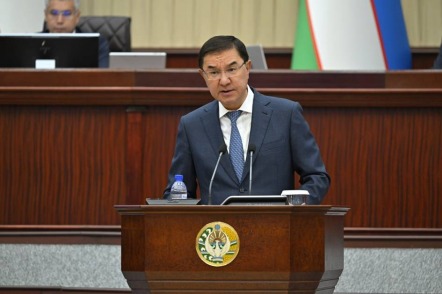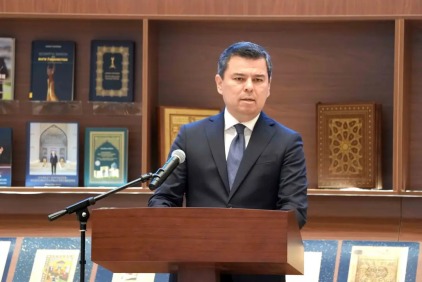
President's spokesman Sherzod Asadov delivered remarks at the "Islamic Civilization: New World, New Initiatives" international media forum, held at the Center of Islamic Civilization in Tashkent.
At the forum, Asadov addressed the challenges facing modern journalism, including artificial intelligence, freedom of speech, national media, and the role of journalists in society.
"Today, information knows no borders. News of an event can reach millions of people within seconds. But alongside that information, lies, manipulation, fake news and information attacks are also spreading rapidly. That's why one of journalism's most critical tasks today is ensuring reliable information," he said.
Asadov also spoke about the rapid inroads artificial intelligence is making into journalism. He stressed that AI does not replace journalists, but rather expands their capabilities.
"However much technology advances, journalism's core principles — truth, objectivity, conscience and serving the public interest — must remain unchanged," the press secretary said.
He also raised what he described as a genuine crisis of free speech as one of the pressing global challenges facing contemporary journalism, noting that in some cases, free speech has been turned into a tool of political pressure, undermining journalism's objectivity and credibility.
According to Asadov, defending national interests does not mean shutting oneself off from the world. On the contrary, he said, it means relying on facts, analyzing events objectively, and maintaining open dialogue with society.
The press secretary also emphasized that a journalist's role is not limited to simply conveying information. Journalists, he said, listen to people's concerns, raise their problems, and ensure that public voices reach government institutions.
Asadov noted that holding the forum at the Center of Islamic Civilization carried particular symbolic significance. The center, established on the president's initiative, is dedicated to showcasing the nation's centuries-old scientific and spiritual heritage to the world.
He pointed to the legacy of scholars such as Khwarizmi, Biruni, Ibn Sina, Imam Bukhari, Imam Termizi, Imam Maturidi, Ulugbek and Alisher Navoi as an invaluable treasure for all of humanity. He noted that Khwarizmi's name lives on today in the term "algorithm" — a reminder, he said, of how deeply connected the legacy of past scholars remains to modern science and technology.
Asadov said preserving national heritage should not be limited to museums and books, but should also involve presenting it through modern digital formats, in language accessible to younger generations, and in a way that reaches the global public objectively.
Stay up to date with all the latest news: