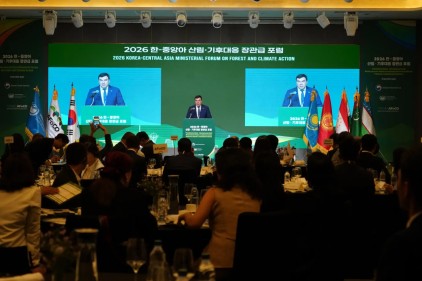
Uzbekistan has put forward a series of new initiatives to expand "green" cooperation across the region. The proposals were unveiled at the Korea–Central Asia Ministerial Forum on Forests and Climate and its accompanying Ministerial Dialogue, held in South Korea.
Aziz Abdukhakimov, presidential adviser on ecology and chairman of the National Committee for Ecology and Climate Change, represented the country at the event.
The forum showcased ongoing efforts to expand green spaces and restore degraded land nationwide. Officials said more than 1 billion seedlings have been planted under the nationwide Yashil Makon (Green Space) program, lifting the country's green cover from 8 percent to 14 percent, with a target of 30 percent by 2030. Forests have also been planted across nearly 2 million hectares of the dried-up Aral Sea seabed, officials said.
At the Ministerial Dialogue, the country proposed moving the "Korea–Central Asia: Green Cooperation" format and the "Green Shield of Central Asia" initiative into a practical implementation phase. To that end, it proposed designating pilot sites in partnership with South Korea, the UN Convention to Combat Desertification (UNCCD), and the Asian Forest Cooperation Organization (AFoCO), along with developing measurable indicators, implementation timelines, and financing mechanisms.
Digital atlas for saxaul forests
The delegation also put forward an initiative to establish a dedicated regional program for preserving and modernizing saxaul forests. The program is expected to cover research into the genetic properties of saxaul, the development of seed technologies, satellite monitoring of saxaul stands, and the use of artificial intelligence. A proposal was also made to create a unified digital atlas of saxaul forests across Central Asia.
Carbon hub for Central Asia
An initiative was also announced to establish a regional carbon hub involving South Korean companies and financial institutions, aimed at attracting investment into land restoration projects. In addition, the country proposed developing an "Arid Lands Carbon Standard" — a dedicated carbon standard for dry regions — in cooperation with the UNCCD and the UN Framework Convention on Climate Change (UNFCCC). The new standard is intended to account for the relatively high costs and complexity of carrying out carbon projects in desert and arid regions.
At the event, the Research Institute for Combating Desertification and Desert Economic Development at Green University was designated as a regional research and practice platform, where joint research, field trials, and pilot projects involving scientists from South Korea and Central Asia are planned.
Stay up to date with all the latest news: